

How To Choose The Best Eco-Friendly Patio Alternative For Your Backyard

When trying to make your home more eco-friendly, you might first change out old lightbulbs for LEDs or try not to run the water while brushing your teeth. These small changes are a great start, but larger changes to your home's infrastructure can be even more impactful. Take, for example, your outdoor patio space. The traditional patio option of poured concrete requires a lot of energy to create, and it is not permeable, which can result in flooding and erosion in your yard.
It's possible to find outdoor patio ideas that can revamp your space without impacting the planet, but to discover the best material, you should first assess the actual needs of your yard. Consider how much rain and heat you get, the durability you need from your patio surface, your budget, and your desired aesthetic. Of course, you should also learn about the carbon footprint of each material and decide if you want something that takes less energy to produce, allows for natural water drainage, or biodegrades well over time.
Some eco-friendly alternatives to a concrete patio include permeable pavement, grass block pavers, natural stone, recycled concrete or asphalt, and recycled rubber pavers. While each one has its own advantages, these have lower environmental impacts than poured concrete, and may even have benefits for your yard beyond their aesthetics. From the surface you choose to the decor you add, conscious choices toward eco-friendliness can result in improved water management, a lower carbon footprint, and greater durability of your patio as a whole.
Sustainable patio materials are recycled, natural, or manage runoff
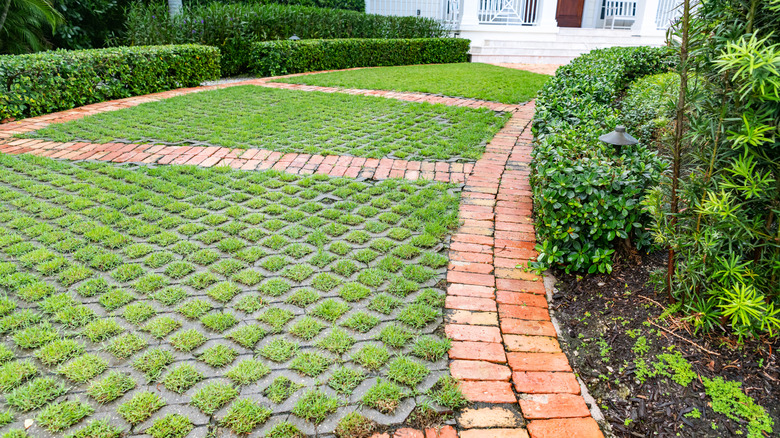
Permeable paving isn't really a type of pavement at all. It's actually a special system of grids that hold gravel or pebbles in place. While the grids themselves are often made of plastic, they can be made from recycled materials, and they can help the environment in other ways. They're great for yards that get a lot of rain because water can seep through the stones rather than pooling and contributing to runoff or flooding.
Recycled materials are another way to go, such as recycled asphalt or recycled concrete rocks, which are taken from demolished structures. These use less energy during their creation, and they can also serve as filler for permeable pavement grids. Recycled rubber pavers have similar environmental benefits by reusing rubber that would otherwise be sent to landfills. Patios made of recycled rubber pavers are very durable and are great for frequently used spaces, as they are shock-absorbent and non-slippery when wet. These recycled materials are also typically cheaper than a new concrete patio, making them a great choice for anyone with a budget while still retaining durability and a classic look.
There are other options for those who want an outdoor space that feels more organic: natural stone and grass-friendly pavers. Typically more expensive upfront, natural stone surfaces are more durable than manufactured ones. They also have a lower carbon footprint than traditional concrete, can be salvaged and repurposed, and are technically biodegradable, although they hold up for decades or centuries. Alternatively, pavers like Turfstone that allow for grass to grow between them could still be made of concrete, but they're a good choice for absorbing water or adding greenery.
Other considerations for an eco-friendly patio area
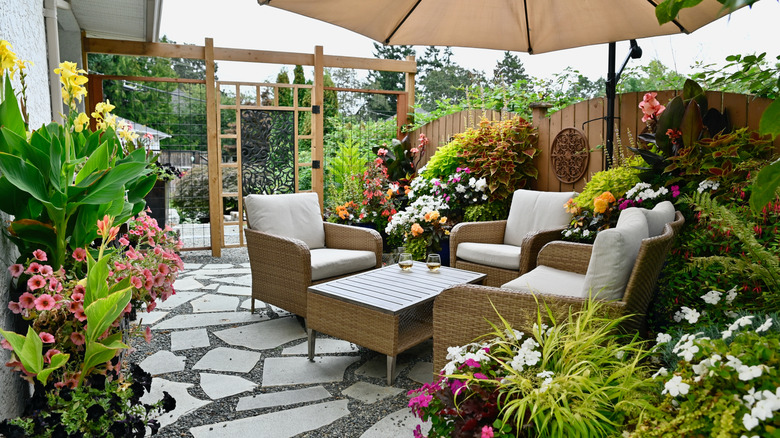
Along with the materials you choose, you should also learn more about sustainable sourcing and installation. By finding local sources for your patio materials, you can reduce the environmental toll of transportation. Avoiding heavy machinery during installation can reduce impact, too. However, it's important to make sure that whatever pavers you choose are installed properly so that you don't accidentally make issues in your yard worse. You definitely don't want to decide on permeable pavers and end up with even more flooding and pooling as a result of poor installation.
On top of the patio — literally — the way you decorate also makes an impact. When buying patio furniture, look for pieces that are made from recycled or natural materials. For example, for an idea that's not vinyl, linen is a great eco-friendly patio alternative. Add native vegetation in planters and in the lawn along the edges of the patio to absorb rainfall and make good use of the space. Shade from an awning, umbrella, trees, or taller plants will also cool down the patio, make it more usable, and even prolong the life of your furniture. After all, keeping the furniture you have rather than buying new is an important way to lessen environmental impact. On a similar note, it may be worth exploring the easy solution to upgrade old patio concrete without having to repave it before deciding exactly how you plan to revamp your outdoor space.