

How To Easily Sharpen Lawn Mower Blades With A Flap Disc
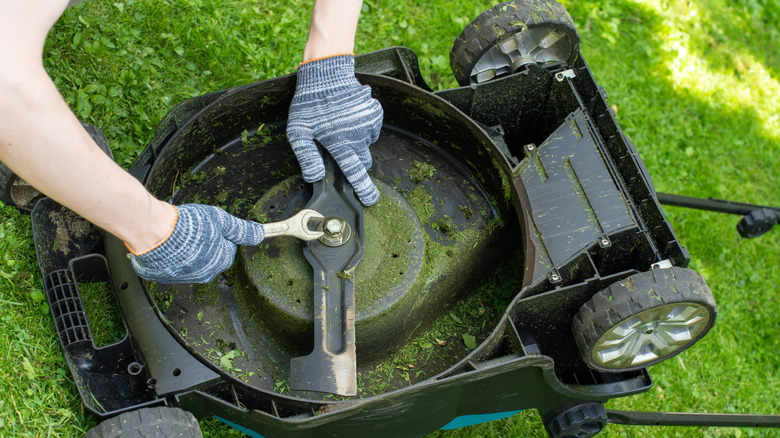
We may receive a commission on purchases made from links.
If your grass has a tired and ragged appearance and you've already tried a list of treatments, the real culprit might not actually be your lawn. Instead, the diagnosis could be as simple as dull mower blades that shred the tips of your grass. When this happens, the end of every blade dries out and turns brown, and you get that frayed look, despite all your other lawn care efforts. It's time to give your mower blades a better edge if they have never been sharpened or your grass is cut unevenly, looks torn rather than sliced, or turns brown at the tips a day or two after mowing. It might be hard to hear that you've been behind the problem all along, but the good news is that an angle grinder with a flap disc is a quick cure for this lawn issue.
Whether you've been blaming it on the heat, the drought, or your lawn fertilization schedule, it's fairly simple to rectify the actual problem. Many people use an angle grinder with a grinding disc to sharpen mower blades, but using a flap disc is a better choice for a couple of reasons, especially for beginners. Flap discs, which are similar to sandpaper, are more forgiving since they don't go through metal as quickly. They also don't create as much heat, so the metal doesn't lose its hardness.
Step-by-step instructions for sharpening your blades with a flap disc
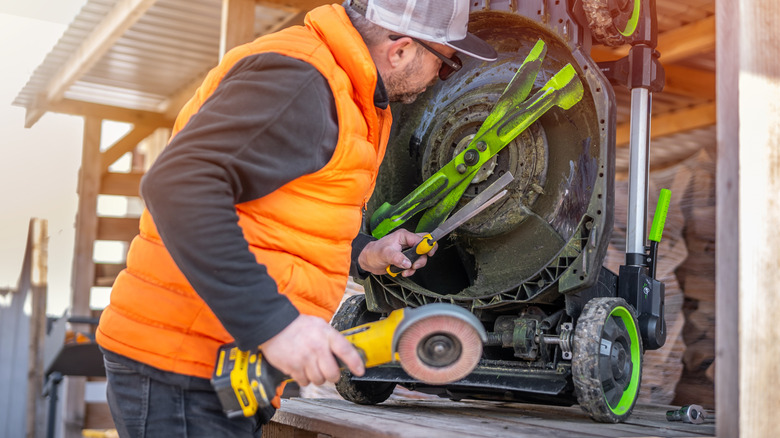
An angle grinder with a flap disc is one of the tools that make sharpening mower blades easier. Here is how to do it. For safety, first disconnect the spark plug or battery wire, and use gloves, eye, and ear protection when working on your lawn mower. Start with an inspection of your mower blades to confirm they're dull. Since they need to be sharpened after about 20 to 25 hours of use, you probably already know the answer to that, but you should inspect the blades anyway. Look for dents and nicks, and if there are significant chunks missing or the blade is cracked, it's time to replace rather than sharpen.
It's easiest to work on the mower when it's on its side, but be sure to keep the carburetor and air filter upright when you tip it back. One useful tip to help you avoid putting the blade on upside down after you sharpen it is to mark it with spray paint or a permanent marker. Then, brace the mower blade with a scrap piece of wood and loosen the nut that holds it in place. For help removing a rusty bolt, start with a penetrating oil like WD-40. Once it's free, clean the blade with a wire brush so you can inspect it, then put it in a vise or clamp before moving the grinder back and forth across the beveled edge until it's as sharp as a knife.
Tips for sharpening lawn mower blades with a flap disc
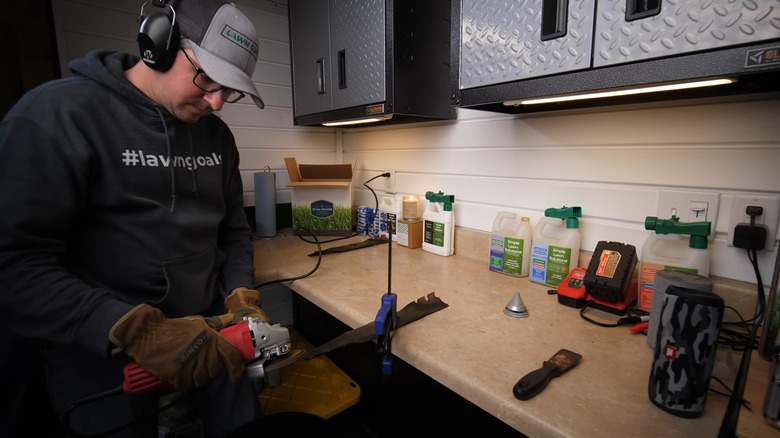
When you're sharpening a lawn mower blade, you don't need to change the bevel that's already on it. You also don't want it to be razor sharp because over-sharpened edges just get damaged faster. One way to tell your blade is sharp enough is to test it on a blade of grass or piece of paper. Try pulling one of these over the blade to see if it cuts through easily, and keep sharpening until it does. While you're working, hold the blade at about 30 degrees. If the metal gets too hot, either take a break or dunk the blade in some cold water so the metal doesn't get soft.
The other factor to consider when you're using flap discs to sharpen your mower blades is the grit selection. For nicks and chips with some depth, consider a coarse 24-60 grit disc, but don't overdo it. Most of your typical seasonal wear requires 60 to 80 grit. However, if you're interested in going the extra mile to get the nicest-looking turf on the block, then light touch-ups and finishing passes with a finer 120 grit is considered acceptable as well. The discs you need can be found at most hardware stores or online, such as the PRETEC Flap Disc Variety Pack from Amazon. This mixed pack of flap discs covers most of the grit selection you need and costs $18.99 at the time of publishing.