

Not Mulberry: The Beautiful Shade Tree With Edible Fruits That Can Stain Your Deck Or Concrete
We may receive a commission on purchases made from links.
There's a lot to love about mulberry trees. They have a dense canopy that provides shade to cool your backyard and sweet, juicy fruit. It is no wonder so many people want them in their garden. The issue, though, is that mulberries are messy — especially the red-fruited varieties. The berries fall to the ground, staining everything they touch a deep blue-purple. Quite quickly, your yard will look unkept. Mulberries, however, are not the only trees that have this issue. Black walnut trees (Juglans nigra) have similar benefits and problems.
Just like mulberry trees, black walnuts are wide — they can spread up to 50 feet. They create dense shade that's perfect for cooling large properties. Once again, though, the fruit is an issue. Even though it's edible and nutritious, black walnut fruit will litter your yard. A single tree can produce between 50 and 80 pounds of fruit a year, much of which falls to the ground before it can be harvested from the canopy. It stains everything it touches, thanks to the dye-containing husks. Concrete, decks, patios, clothes ... Nothing is safe.
Other than that, the fruit is a slip hazard, and it can dent cars or other objects underneath the tree. It's not just the fruit of the black walnut tree that creates a mess. The fallen foliage is messy, too. Each deciduous walnut tree can produce around 100,000 leaves annually, and these leaves drop as the weather cools, adding to the litter problem. Put simply, if you're looking for a shade tree that won't leave a mess, the best options are neither mulberry trees nor the black walnut trees.
Where to grow a walnut tree and what to plant instead
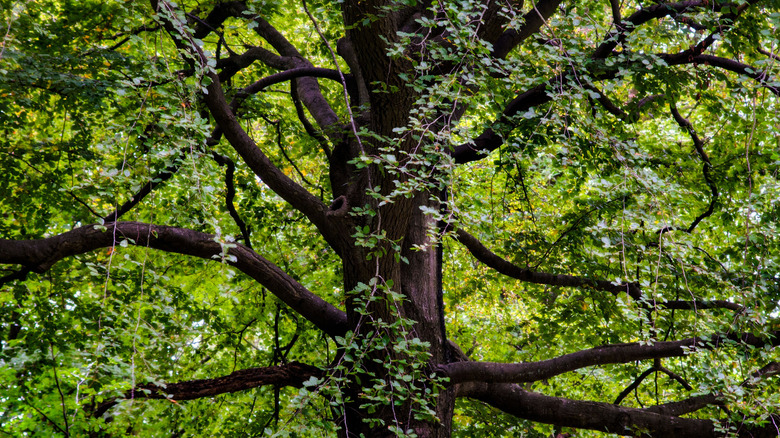
Black walnut trees are one of those plants that you should avoid growing next to anything else. This includes patios, decks, sidewalks, driveways ... anything you don't want to get stained. However, you can safely plant them in open space. The falling fruit won't do any damage to an expansive lawn, where it's simply an attractive specimen and shade tree. If you really want to plant black walnut near landscaping, try to minimize staining by installing a temporary Inefaro Fruit Catcher or commit to picking the fruit as soon as it ripens, before it has a chance to fall. If, however, you would prefer to avoid the mess altogether — or all the hard work involved in collecting the fruit — forgo planting black walnut and mulberry. There are other, less destructive common shade trees that can also help lower your AC bill in the summer.
Two good examples are Japanese maple (Acer palmatum) and 'Little Gem' magnolia (Magnolia grandiflora 'Little Gem'). Japanese maple has a graceful, layered canopy that will cast a light, comfortable shade in backyards large and small. Plus, its delicate leaves are striking in fall, when they turn brilliant shades of red, orange, yellow, or purple. 'Little Gem' magnolia, on the other hand, is denser and more upright, making it useful for privacy and shade. Furthermore, its glossy, evergreen leaves ensure your garden looks polished year-round. Its creamy-white flowers are also alluringly fragranced. Both of these shade tree alternatives give welcome relief from the hot sun without the messy falling fruit.