

They Go Back To The Qing Dynasty — Now It's The Rare Porcelain Vase Worth Hunting For
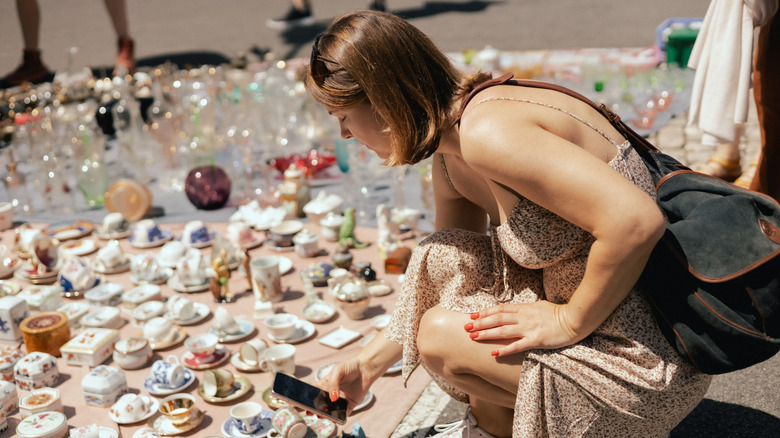
While it's a rare find, Qing Dynasty porcelain made from 1644 to 1911 includes many patterns and styles of valuable Chinese pottery. Qing dynasty designs featuring Famille Rose tones, like the Rose Medallion pattern, are vintage dishware patterns to keep an eye out for when thrifting, but Famille Rose vases are an even more treasured prize find. In fact, they may even be the once-in-a-lifetime kind of find that any antique thrifter would be telling stories about for years. After all, you never know what you'll find at the local thrift store after a generous donation or estate sale. Famille Rose porcelain is prized for its unique color palette more so than the actual design, with colors centered on opaque shades of pink painted over a fired glaze.
The artistry, craftsmanship, and historical origins of Famille Rose porcelain affect the overall value, but because these pieces are so rare and historically significant, they could be worth more than you'd expect from a thrift store find. For example, a Famille Rose vase discovered in an attic sold at auction in 2018 for €16.2 million (over $18.5 million USD). A great example of these pieces are for sale (at the time of writing) with 1st Dibs priced at $38,000 for a set of two Century Chinese Famille Rose Decorated Porcelain Vases with Striking Foo Dog Handles.
Less rare finds are generally still sold at auction for several thousand dollars. In 2015, "Antiques Roadshow" appraised a 1835 vase that fit in the palm of an adult hand for $6,000 to $8,000. A similar piece was appraised at $3,000 to $5,000 in 2025.
What is the Famille Rose vase design and why is it such a good find?
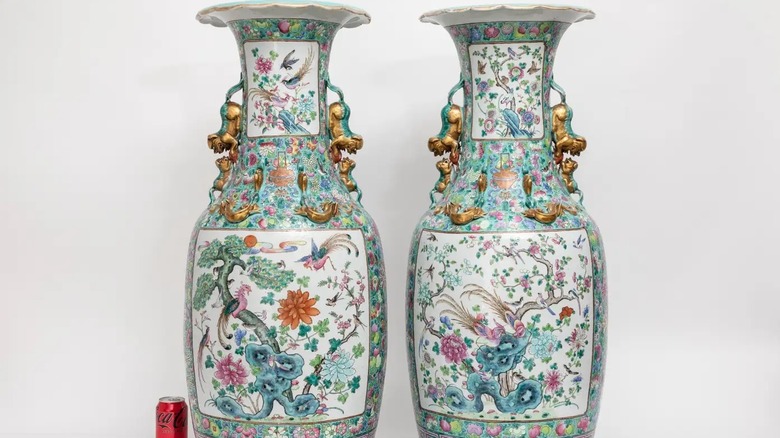
Naturally, Qing dynasty porcelain is sought-after in general, but large Famille Rose vases are particularly desirable for several reasons. Technically, the color palette for this design didn't emerge until the 1720s. Throughout the 18th century, Famille Rose vases also became more intricate, with layered painting techniques that were revolutionary at the time. From the outlines of the leaves and the soft glow using mixed tones of enamel to the individual hairs or scales delicately painted onto each animal figure, these vases were crafted with immense care. Famille Rose pottery features three common designs that sell particularly well at modern auctions: Rose Medallion, Rose Canton, and Rose Mandarin.
In addition to the artistic influence the style had in China at the time, Famille Rose designs were known for blending art styles to be marketable in both Eastern and Western markets. The style was intentionally crafted for the global luxury art trade, making a huge impact in European collector markets. Pieces made in the mid-18th century, particularly those made between 1725 and 1755, are usually considered the most valuable. By the 19th century, the detail began to wane in quality, and even though the vases had the same core themes and color palettes, the final designs lacked the depth of the original style of the Yongzheng and Qianlong periods.
Identifying and authenticating Famille Rose vases
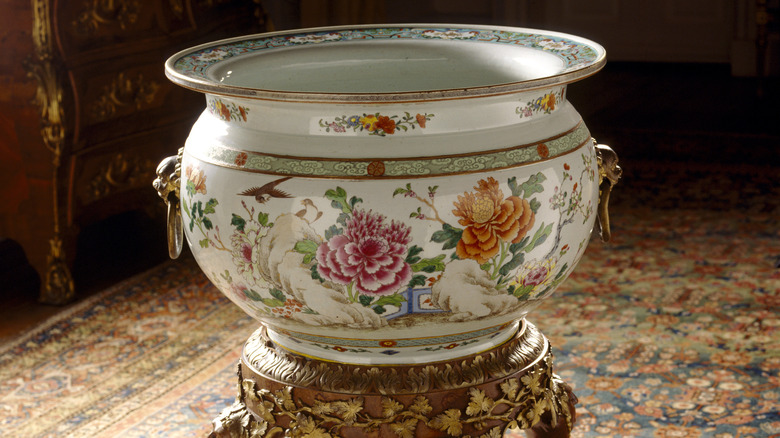
If you're wondering how to authenticate your latest thrift store find, your best bet is to take it to an experienced antique dealer. However, there are a few things you can look for that may indicate its authenticity. The best indicator is the art style and color palette. Bright orange is a red flag! Original Famille Rose pieces have a muted shade of orange. Famille Rose vases from the Qing dynasty feature highly detailed paintings with soft, hand-brushed art that was washed on in layers. This created a very distinctive shading style. In later styles, the color seems more one-dimensional, with a stark difference between the dark and light shades. The glaze is another good indicator. If the glaze appears shiny or reflective, you may have a reproduction, as authentic glaze ages and softens to diffuse light rather than reflect it.
One of the most misleading things that catches people off guard is the stamp. When you look at the bottom of the vase, you might find an imperial mark. If you don't find one, that doesn't necessarily mean it isn't authentic. In fact, the stamp itself can be misleading. The Qianlong period during the Qing dynasty is regarded as one of the most valuable periods for Famille Rose vases. It is common to find Qianlong marks with a date in the 1700s that were actually made later in the 1800s due to international trade. The mark is usually taken into consideration with other deciding factors, like the actual quality and style of the art. Specific colors like iron-red are indicative of earlier periods, because of the enamels available at the time.