

Use This Bathroom Staple To Give Your DIY Workspace A Comfortable Upgrade
We may receive a commission on purchases made from links.
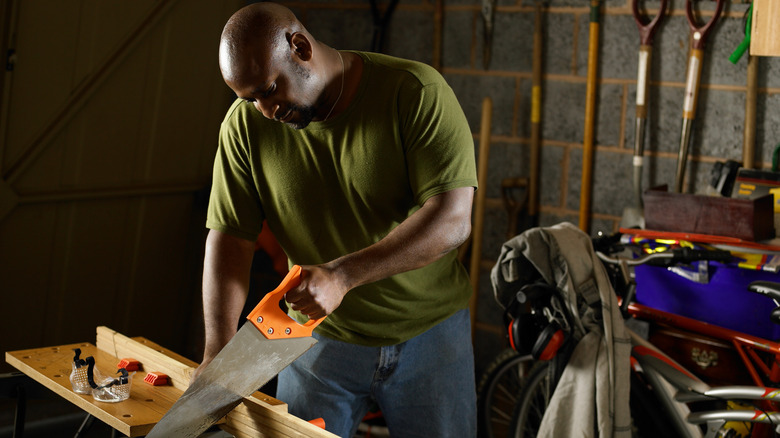
Some DIY projects can be done in a jiffy and don't require much, if any, bending. Others require you to work while kneeling — and possibly remain on your knees for extended periods of time. A Dewalt Heavy-Duty Metal Rolling Stool can help in some cases, but sometimes, you simply need to get down closer to whatever it is you're fixing or building. If you don't have any pads, you're stuck kneeling on the cold, hard concrete floor of your garage — and it's not the most forgiving surface for your joints.
Before you add a pair of knee pads to your weekly Amazon order, you may want to take a peek in your bathroom or linen closet instead. You could be overlooking something that's typically used for drying your feet after a shower — that cushy bath mat. Yes, these small mats can double as surprisingly effective, cushioning pads, giving your hardworking knees some much-needed support.
The best part of this solution is you likely don't even need to buy anything new. It's yet another example of how common household items can be repurposed into unique DIY home decor — or, in this case, helpful orthopedic supports. Of course, if you don't have any spare bath mats lying about the house, you can purchase one for well under $10. This Minidear Gray Plush Non-Slip Bathroom Rug goes for about $8, while this Cupic Cupid Super-Soft Memory Foam Bath Mat costs even less — around $7.
Why bath mats work as kneeling pads and how to put them to good use
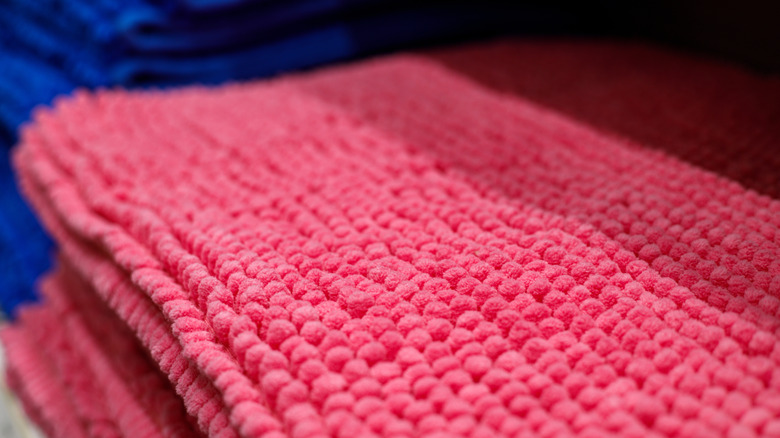
It's not like buying a pair of knee pads is a huge expense. A pair of one-size-fits-all AWP Ultralight Foam Knee Pads costs about $6. However, knee pads are notorious for sliding down your leg as you shift between kneeling and standing. If you don't mind constantly fixing your pads, it's fine, but switching them out for a comfy mat may be the budget-friendly find that'll level up your garage. The success of this hack relies on choosing a bath mat that's as thick and plush as possible — one that's made of memory foam, chenille, or high-pile cotton. These materials are designed to absorb impact and provide comfort on hard surfaces. On top of the support of this extra padding, most bath mats feature a non-slip underside made from some kind of thermoplastic — think rubber, PVC vinyl, or latex.
Once you have the right bath mat, using it in your garage or workspace couldn't be easier. It's similar to this clever way to repurpose an old rug around the house, which you roll up into a makeshift kneeling pad for household chores. Simply lay the mat flat on the floor right in front of your worktable or whatever project you're working on and kneel on it. You can even lay down multiple mats around your workspace or DIY job for total convenience — if, say, you're repairing something long, like a bicycle. Consider folding the mat in half or stacking two mats for extra padding. Also, if your mat isn't non-slip, place a piece of non-slip shelf liner, weather stripping, or even an old yoga mat underneath it to keep it steady as you move around your project.