

Not Banana Peels: The Common Kitchen Scrap You Should Add To Compost For A Nutrient Boost
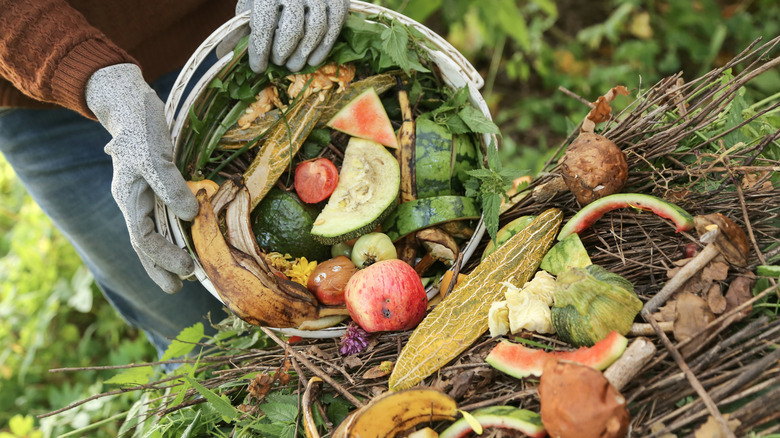
Whether you want to help the environment or produce as much compost for your garden as possible, you need to add the most beneficial kitchen scraps to your pile. Google compost additives and you'll come across a lot of familiar items — some that are safe, some that are unsafe, and some that are ambiguous. For example, you may have heard that you can't add citrus to a compost pile when actually, it's fine. There are kitchen scraps you should never add to your compost, like dairy, but lime peels aren't one of them.
In fact, throwing the peels of lime — and lemon, grapefruit, and other citrus fruits — into your compost is actually good for it. They add important nutrients into the mix as they break down, including nitrogen, calcium, and magnesium. This citrusy fruit may be the secret to keeping mice out of the garden, too, as well as other pests. By adding lime peels to your compost, you'll eventually spread them around your garden. Banana peels, by comparison, release a modest amount of nutrients into compost and can attract pests.
There's another rumor that lime peels (and citrus peels broadly) never break down. While they do take a bit longer to decompose than other green — or high nitrogen and moisture — materials, they will eventually disintegrate. Generally, you can expect lime peels to take about six months to break down, though in hot composting, it can be as little as a few weeks. Cutting up the peels and mixing them deep into the compost pile can aid the process; they won't turn dry and leathery.
Don't use just lime peels — balance your compost
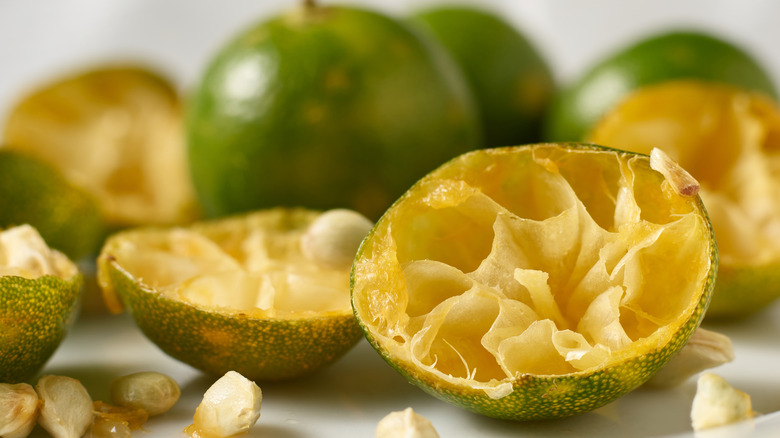
As mentioned, it's not just lime peels that will add a boost to homemade compost. All citrus fruits are a common kitchen scrap you should start adding to your compost pile. Anecdotally, professional composters, homesteaders, and orchard owners who go through lots of citrus happily admit to regularly adding large volumes of citrus to their compost bins. Still, it's not a clear-cut issue. "If you're juicing oranges five or six days a week for three or four family members, that can overload a compost," said Costa Georgiadis, host of Gardening Australia, to ABC News in April 2019.
As with most compostable materials, you don't want to just add a ton of lime peels to your pile. Adding a lot of lime peels once can lower the pH levels in your compost, making it more acidic, which can be temporarily harm your mix. While a little acidity is okay, sticking to a balance of green and brown materials in layers helps maintain compost health — a good rule of thumb is two or three parts brown to every one part green. Thankfully, the acidity doesn't last long — the lower pH levels will neutralize as the peels decompose.
Thankfully, compost piles are generally pretty forgiving, and they give you a lot of room to experiment. Start by adding just a few lime peels and see what happens to your pile. You can always try adding more next time. For example, if you have a lot of lime peels leftover after making a big batch of limeade or a few key lime pies, add them into your compost bin in batches. You can also dry and powder them or blend them to aid decomposition.
If you vermicompost, add lime peels to your bin with caution
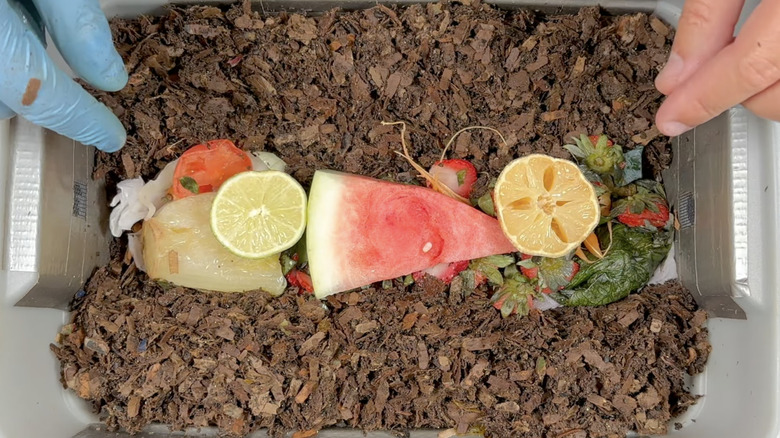
The dangers of adding lime peels to your compost are mostly myths — with a few reasonable caveats like ensuring your compost has a balance of materials. However, you may still want to keep them away from your vermicompost, just to be on the safe side. While many experienced worm farmers regularly add citrus to their bins, the jury's out on their safety.
Worms in outdoor compost piles, where they're free to come and go at will, aren't likely to be affected by a few lime peels. However, in vermiculture, the worms are confined to bins and live entirely on what's fed to them by their owner. They munch on decaying or decayed material. If you add mostly fresh lime peels to their bin, which take quite a while to break down, they may end up with nothing to eat. Alternatively, they may be forced to ingest harmful substances, like penicillin from mold — which citrus is prone to — and a natural insecticide in the peel called d-limonene.(Limonene is also toxic to cats.)
If you do decide to try feeding your worms lime peels, approach it slowly, just as you would your compost pile. Add the peels from just a couple of limes — say, ¼ pound to ½ pound — at a time to give the worms time to get used to the new addition. Monitor your farm to see how quickly they're consumed by your worms and whether you're seeing more deaths than usual. You could also freeze the peels and thaw them out again before adding them to the bin, to make them softer.