

The Circular Feature That Makes Gravel Driveways More Functional And Polished

Do you wish you didn't have to back out of your gravel driveway? You probably find the process even more terrifying if have to back into traffic on a busy road or your driveway has blind spots that could result in tragic injuries or fatalities to pedestrians. Depending on the length of your driveway, you may even be required by local ordinance, based on International Fire Code, to provide a way to turn around in your driveway so first responders in a fire or emergency do not have to back out. A circular turnaround in your gravel driveway addresses these safety concerns while also adding elegance and convenience.
Adding a turnaround to a gravel driveway has one challenging aspect — when a vehicle turns on gravel, loose stones are scattered. A rut can form, and the driveway may need to be regraded. Fortunately, you can mitigate this issue when you create your turnaround.
Overall, gravel is cheaper and faster to install than asphalt or concrete. It's also easier to repair, and its permeability is advantageous for drainage. A circular turnaround can be an attractive solution that will not only make your gravel driveway safer, but will also provide extra parking for multiple guests.
How to add a circular turnaround to your gravel driveway
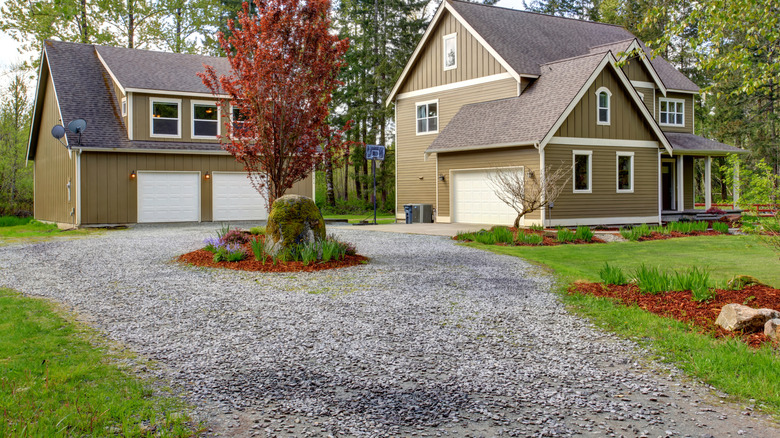
As opposed to a full circular driveway, which takes up quite a bit of space, consider a turnaround design that adds a looped section drivers can use to continue their path without reversing. While classified as circular, this style is sometimes called a "teardrop" turnaround. The two ends of the half-circle driveway meet the road, but the teardrop style has just one exit, so the driver drives forward through the teardrop, rejoins the driveway, and exits onto the road from the same place they entered. You may want to add interest by adding plants, a rock garden, or water feature in the center of the teardrop or circle.
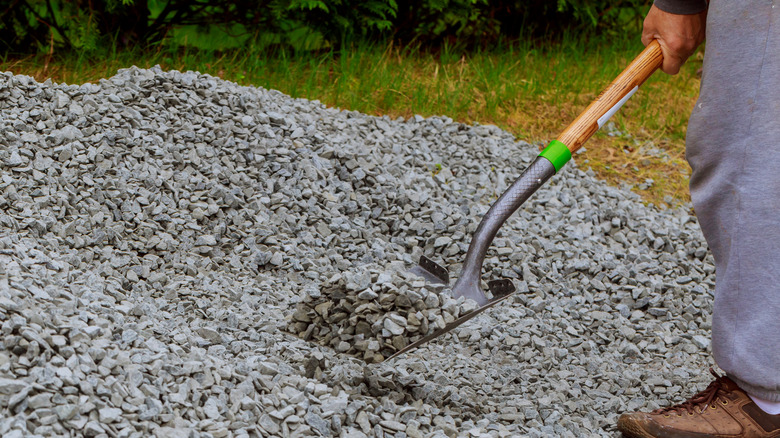
Except for the curved aspect, creating a turnaround is no different than building a gravel driveway in the first place. You'll first need to excavate 12 to 18 inches of soil (more if your soil is soft) and compact a stable sub-base. Learning more about how to choose the best base material is wise if you're unfamiliar with your options.
You may want to to install a weed barrier, but skip traditional landscape fabric, and go for a durable option for gravel driveways: stabilization fabric. Add three layers of gravel in decreasing sizes, so the smallest rocks are on top. Be sure the gravel is mounded like a crown in the middle of the driving area of the turnaround and sloped downward so water runs off toward the edges.
Accommodating curves and shifting gravel
You'll need to determine the ideal size of your turnaround based on the types of vehicles with will use it. If you expect everything from sedans to large delivery trucks, provide the maximum of 25 to 30 feet.
As noted, one of your biggest challenges with a circular gravel turnaround is keeping the gravel in place as vehicles make tight turns within it. Choose angular gravel, the best gravel for your driveway because it creates a stable surface. Grid systems can also be helpful for gravel stability, but while these products hold gravel in place, they but can be expensive and require precise installation.
Structural driveway edging in concrete, brick, plastic, steel, or aluminum is also an option for keeping gravel in place, with metal and concrete considered the most effective choices. Some of the best ways to keep your gravel driveway secure and locked in place will also work for your gravel turnaround, such as adding mulch glue and digging a rainwater trench, but proper installation should always take top priority over quick fixes.