

Stop Struggling With Compost: The Right Tool Is In Your Shed
We may receive a commission on purchases made from links.
Your composting journey probably started off easily enough. You purchased or built your own compost bin and found the perfect spot for it in your backyard. Ever since you got it into position, you've been faithfully filling it with layers of brown and green materials. You even know that browns are rich in carbon and greens are rich in nitrogen. Now, however, the time has come to turn those lasagna-like layers. Without the right tool, this is a task even the hardiest gardener may struggle with, particularly if you have a large compost pile. If you have a garden fork with sharp tines, you're in luck. This most essential gardening tool can make tending to your compost a breeze. Once you start turning your compost regularly with the right tool, you can speed up its transformation into a helpful soil amendment.
You need to turn your compost pile regularly — recommendations range from a couple of times a week to once every four weeks, depending on the season and how much of a hurry you're in to use this free fertilizer. Turning your compost introduces air into the decomposing matter, ensuring any oxygen-starved microorganisms get what they need to keep breaking down those greens and browns. You'll notice your compost pile getting hotter as these hard-working critters are reactivated. A shovel works well enough for a small compost pile, but once your heap has grown in size, it isn't the ideal tool for the job. Instead, a long-handled garden fork — also aptly called a compost fork — will allow you to poke deep into all that decaying matter, lift it, and turn it with ease. Plus, you might already have one in your shed right now.
Choose the perfect garden fork to turn your compost pile
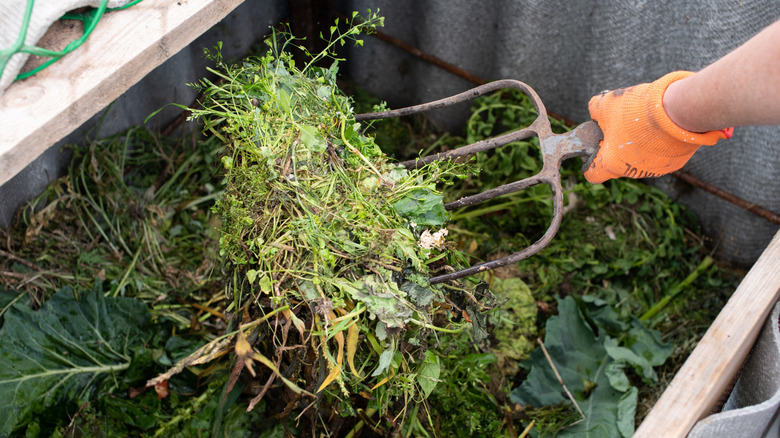
You'll find all kinds of garden fork styles on the hardware store shelves or maybe even among the tools in your own garden shed. They're some of the best tools to have on hand when dividing plants, moving manure, harvesting root vegetables, and digging weeds out of garden borders. However, turning your compost pile is a must, as is mixing it, and some fork designs work far better than others for this task. You need a garden fork with a long handle and thick, sharp, slightly curved tines. This type of tool is well suited for compost, making it easy to cut through, pick up, and toss heavy, damp layers of decomposing organic material.
Once you've found the right style of fork, you can narrow things down even further. First, you need to check that your compost fork has a handle that's the right length for you to comfortably lift and scoop piles of vegetation and decomposing food scraps. Essentially, the handle needs to be long enough to prevent any stooping when you're using it. You should be to grip the handle with your arm at a 90 degree angle when standing upright. The total length of garden forks typically ranges from 42 inches to 60 inches. A fork with at least five tines is best for turning a compost pile. This Vnimti Heavy-Duty Compost Pitchfork costs $50 and is 58 inches long, has 10 tines, and boasts a sturdy fiberglass handle. If you need something a little shorter, the six-tine Truper TruPro Forged Manure Fork comes in at 54 inches tall and costs a bit over $66.