

It Isn't Pyrex: The Vintage Glass Cookware That's Just As Nostalgic
We may receive a commission on purchases made from links.
When you think about a long-standing line of glass cookware, brands like Pyrex might pop into mind, and for good reason. After all, it's been around since 1915. But while Pyrex might be a popular household name, it didn't come up alone. Another company was finding its footing around the same time that would then go on to rival other iconic brands: Anchor Hocking.
If you love vintage cookware as much as we do, you don't want to sleep on Anchor Hocking. In fact, you might have even seen some of the more nostalgic Anchor Hocking pieces at your local thrift store. Maybe it was the 'Green Meadow' milk glass baking dishes that stood out, with their green and yellow flower designs along the side. Or maybe, like Martha Stewart, the mint green Jadeite dishes caught your eye. In her '90s-era show "Martha Stewart Living," she shoots episodes in her own kitchen where you can see her incredible Jadeite collection in her windowed cabinets. Anchor Hocking might just be one of the decades-old kitchen cookware that's making a stylish comeback today.
Though many of the popular glass cookware came out of their Fire-King line, circa 1942, the company actually originated in the early 1900's. Founded by Isaac J. Collins in 1905, they quickly became the number one producer of Depression Glass — a type of glass that was cheaper to mass-produce — by 1929. Back then they went by Hocking Glass Company, before eventually merging with Anchor Cap and Closure, and re-emerging as Anchor Hocking Company. Having gone through a series of sales, purchases, and bankruptcies, the company has downsized back to a singular manufacturing location in Lancaster, Ohio, where it all began. Today, they primarily manufacture soda lime glass products.
The vintage Anchor Hocking gives pure nostalgia
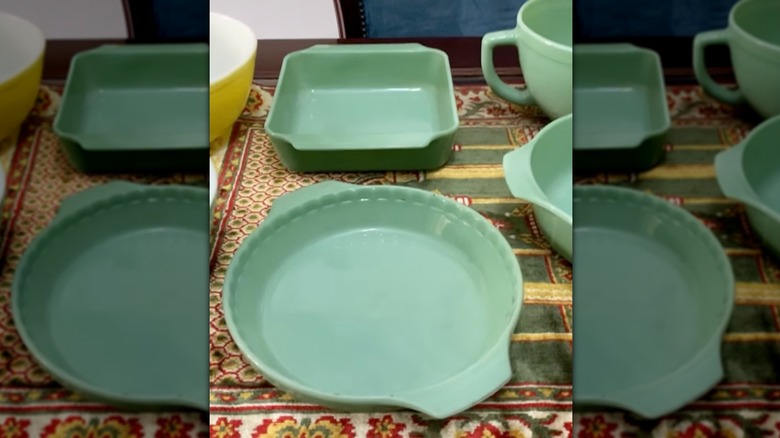
If you want to find a vintage Anchor Hocking piece that's going to give you that classic hit of nostalgia, seek out the Fire-King line, a valuable and vibrant cookware to look for in thrift stores. Originally manufactured from 1942 to 1976, it's become the it-piece to have in your vintage collection of glass cookware. The name was derived from its ability to withstand high heat, giving it the functionality to be used for cooking while also having the aesthetic appeal for serving.
Many of the Fire-King pieces are valuable vintage items you can thrift that collectors want to get their hands on. A Philbe Sapphire Blue casserole dish, one of the first of its kind, is worth $150 to $400. Pie dishes from that same line are valued anywhere from $80 to $150, and items from the famous Jadeite line can run as high as $500 or more. But their value is more than monetary, as their durability enables you to actually use these pieces in your kitchen as long as they're not painted. Just be sure to hand wash each piece and steer clear of the dishwasher. Painted dishes should be display only since their paint may contain lead.
Whether you're searching online sites like eBay or venturing out to thrift stores and estate sales, it's important to know how to spot an authentic Anchor Hocking Fire-King item. The quickest way to ensure authenticity is to flip the item over and check for a specific marking. Early pieces from the 1940s and '50s have "FIRE-KING" embossed on the bottom, while others from the 1950s and '60s might say "FIRE KING OVEN WARE". Later pieces, like ones made between the 1960s and '70s, often have "ANCHOR HOCKING" above the words "FIRE-KING."