

5/8-Inch Vs 3/4-Inch Garden Hoses: Which One Is Best For Your Home?
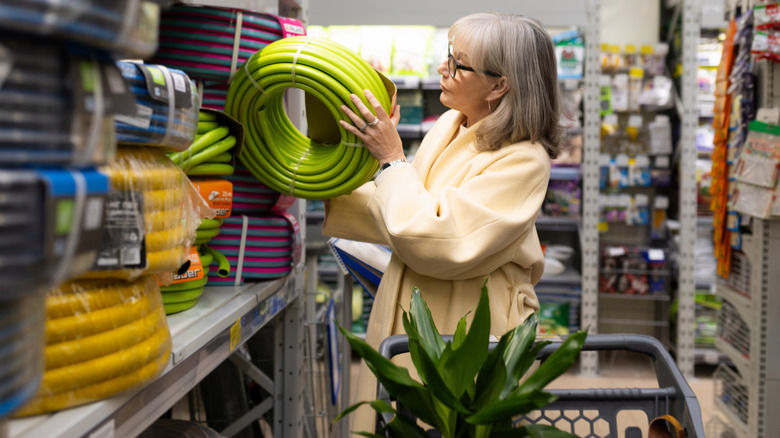
You shouldn't need an instruction manual when you're shopping for garden hoses, but if you've done that recently, you might have wished for one. Not only are there different colors and lengths, but you also have to choose between lightweight, medium, and heavy-duty hoses. And then there's size, which might be one of the most confusing features of all. If you're wondering whether to buy a ⅝- or ¾-inch hose for your backyard spigot, the ideal diameter depends on everything from how often you water your lawn to how large your yard is.
The number on the label refers to the inside diameter of the hose, which determines how much water your hose delivers. A smaller ⅝-inch hose won't deliver as much water as a larger ¾-inch hose. For most residences, a ⅝-inch hose is fine for running sprinklers, feeding drip systems, filling the kiddie pool, and washing the car. But if you're growing a large extensive garden or have multiple sprinklers on a longer run, then a ¾-inch hose is better. Apart from internal diameter, the hoses also have a difference in flow rate, weight, and durability.
Find the right hose size for your home and garden
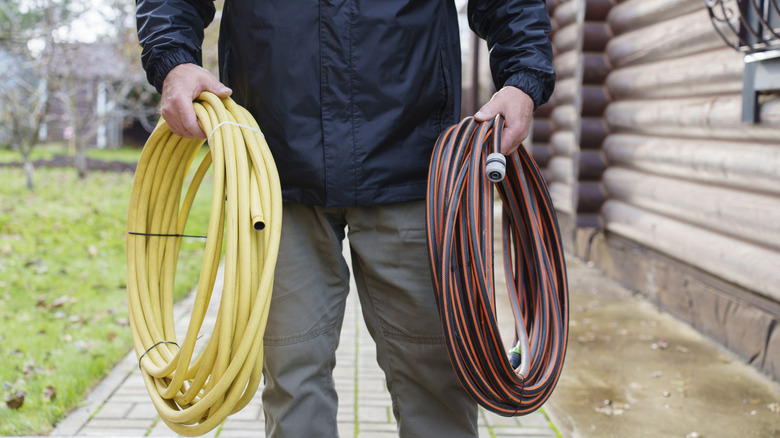
While the majority of people can get away with ⅝-inch garden hoses for everyday use, a ¾-inch hose is better for large or heavy-duty jobs. For most residential water systems, which operate at about 40 to 60 psi (pounds per square inch), a ⅝-inch hose has a 9 to 17 gpm (gallons per minute) flow, whereas a ¾-inch hose delivers about 50 to 80% more water at 15 to 25 gpm. The large diameter means it can manage greater water pressure, and you can tackle chores faster, making it a way to conserve water in your home. If you're curious about how much water you're using, try an online garden hose flow rate calculator to see how hose length, diameter, and water pressure impact the flow rate. Or, for greater accuracy, use a bucket and stopwatch to time the flow and calculate the results from that.
When you're shopping, weight is another factor to consider, since hoses can get pretty heavy when they are full of water and you're dragging them all over the yard every day. A ¾-inch hose is usually heavier and less flexible than the ⅝-inch alternative due to its thicker material. However, that also makes it more durable and helps prevent kinks in your garden hose. Further, any hose at least 100 feet long should probably be upgraded to a ¾-inch diameter to minimize loss in water pressure over the long distance. For hand watering, small sprinklers, or medium-sized gardens, a ⅝-inch hose is adequate. But for outdoor spaces over 3,000 square feet with large irrigation systems, a ¾-inch hose is your best bet.