

Trade Traditional Bathroom Cabinet Doors For A Creative Way To Add Japanese-Inspired Charm
We may receive a commission on purchases made from links.
Whether you're making an affordable DIY shelf with a Zen Japanese aesthetic or decluttering your home using the KonMari Method, you're tapping into an emerging trend. Even bathrooms aren't immune to a touch of Zen-inspired design. In fact, you could argue bathrooms are the area of the home where this approach is most prevalent. Japanese interiors are often minimalist, full of natural materials, and feature a neutral palette — all these elements come together to create a tranquil space. If you want to cultivate this aesthetic in your bathroom, consider starting with this easy, stylish upgrade. It's time to ditch the traditional Shaker-style doors on your vanity cabinets for a sliding Japanese-inspired fluted design.
There are two parts to this DIY: creating the fluted wood effect on your existing cabinet doors and building your own sliding cabinet door. If you're up for the challenge, you're going to need to gather together a few supplies and tools before you can get started. To make the sliding door, you'll need a Shalaxera Sliding Cabinet Door Track and Aluminum Hardware kit for about $40 (or any similar kit). You'll also need a hole saw, a pack of wood screws, and a drill. Now, it's time to address the fluting on the door. The easiest way to achieve this look is to purchase a pack of Inmozata Beaded White Oak Slat Wood Panels for around $150. Some people even use this fluted wood panelling to improve acoustics in their home. Who doesn't want to improve their shower singing? You'll also need a circular saw, table saw, or hand saw to cut them to size, some caulk in a suitable color, and some moisture-proof grab adhesive.
How to DIY a Japanese-inspired fluted sliding door for a bathroom vanity
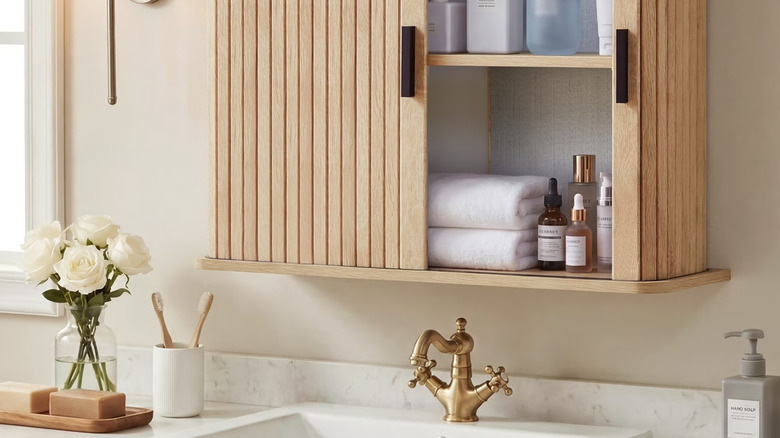
Ready to try making this stylish DIY fluted door that upgrades any room? You'll first add the fluted wall paneling to your bathroom vanity cabinet door (or doors) before adapting it into a sliding door. It's the most straightforward approach. Remove your vanity doors and lay them flat on your work surface. Cut the fluted panels to size with whatever saw you have on hand. Apply the grab adhesive directly to the cabinet door and attach the fluted panels to it. Apply some pressure with your hands or use clamps to keep the paneling in place if needed. Use some Loba Light Oak Gap Filler — or a caulk in another matching color — to seal the edges.
Looking for a simpler alternative to fluted panels? You could use peel-and-stick Yu Li 3DH Peel and Stick PVC Slat Wall Panels for a bit over $33 a sheet instead. Light-hued natural wood like oak, ash, and maple is classic in Japandi design — a combination of Japanese and Scandinavian aesthetics. However, if you'd prefer cabinet doors that match your existing bathroom palette, now is the time to paint them.
Sliding cabinet door kits come in a huge range of sizes, so measure your cabinet door accurately before ordering the hardware to make sure the length of each is a match. As soon as your kit arrives, you can get started on this final step in the project. Screw the top and bottom tracks inside your bathroom vanity using a screwdriver or a drill. Use a hole saw of the correct size to cut half-depth glide holes on the cabinet doors, then screw the tracks onto the doors with a screwdriver. Carefully hang your new Japanese-inspired cabinet door and adjust accordingly.