

Your Stairs Need An Upgrade: Build A Railing That's Cheaper And Sturdier
We may receive a commission on purchases made from links.
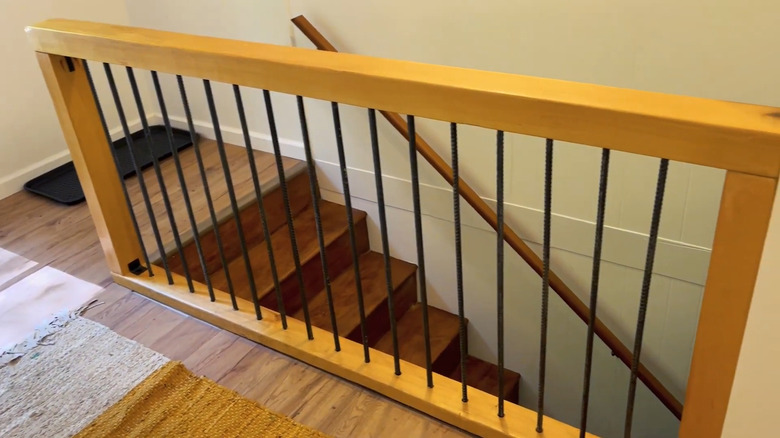
Sometimes it can be hard to tell which mistakes to avoid as a new DIYer. Some projects require professional assistance, but you don't figure that out until it's too late and you're already in over your head. Watching other people make mistakes on DIY projects offers more than simple entertainment. It can help you learn which projects may end in disaster and which are more DIY-friendly. If the railings on your stairs need an upgrade, there's one option that's suitable for home carpenters: making them from dimensional lumber and ½-inch rebar. Bonus: It's a cheaper and potentially sturdier alternative to traditional handrails built by professionals.
Whether you are building handrails for inside your house or out on the porch, this design uses rebar in place of more traditional steel, wrought iron, or turned wood balusters. Rebar balusters are easier to maintain than wood (something you'll know if you've ever repainted timber spindles) and less expensive to purchase than steel or iron. Instead of paying more and getting less, you end up with a durable and affordable handrail that's industrial and rustic all at once — and arguably offers better visibility than a traditional wooden version.
Rebar balusters are inserted into holes drilled into the lumber. All you need to do is drill about 1 inch deep into the top and bottom rails for each length of rebar. Check your local code requirements for spindle spacing to make sure you meet the safety criteria — these differ by area and building occupancy type. Wondering how much stair railing installation costs? This is a money-saving tip to consider because professional labor averages $50 to $200 per linear foot. It's easy to see how this is a more cost-effective option.
Cost and durability decisions to make when DIYing a rebar stair railing
Rebar is used to add strength to poured concrete buildings, so it's hard to beat its durability. You can even turn this simple scrap metal into an ornate birdbath. For the lumber, you can make this handrail from 2-by-4s, 2-by-6s, or 4-by-4s. Which species of wood you choose depends on how much you want to spend, how sturdy or long-lasting you want the handrail to be, and the aesthetics of your home. Just keep in mind that some species of wood cost a lot more than others. If you're on a budget, 2-by-4 pine, spruce, or fir lumber finished with wood stain is a good choice for indoor railings. For outdoor railings, you could go with budget-friendly pressure-treated pine or pay a little more for naturally rot-resistant cedar or redwood.
You'll also need roughly 60 balusters for every 20 feet of railing. If you cut and prepare the rebar yourself, rebar balusters cost about half as much as other options. The #4 Rebar you need for this project comes in 20-foot lengths — called sticks — and each stick cost just under $15 each at Home Depot. As a quick cost comparison, WeatherShield Pressure-Treated Wood Spindles from Home Depot cost about $4 each. The store also carries House of Forgings Satin Black Twist and Basket Hollow Wrought Iron Balusters, which start at around $5 each. Check the railing height requirements in your county or state to ensure what you build is code-compliant. For example, railings in Knox County must be 36 inches tall. Using this as an example, if you buy 2-by-6 lumber, you'll be able to get eight balusters from one stick, bringing the cost of rebar balusters to around $2 each or less.