

Why Are People Are Pouring Salt Down Their Drains, And Should You Try It?
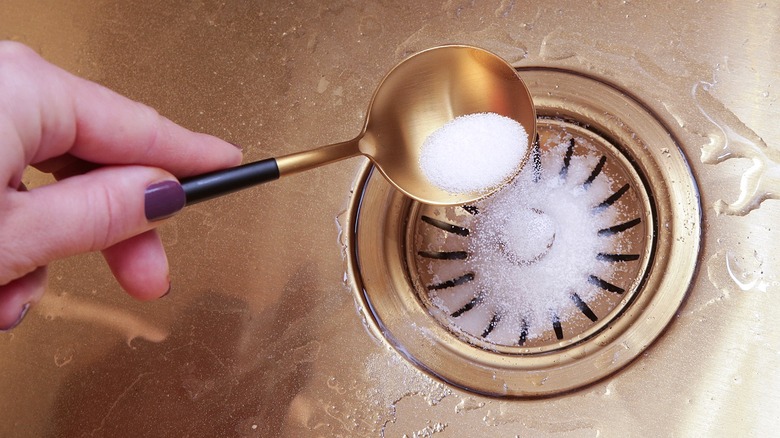
In the United States, the average cost of having a professional clear out a clogged drain is about $245. Considering this, you might turn to social media-approved remedies to unclog your sinks and drains yourself. This holds especially true if the solutions are low-effort and involve using common pantry ingredients to bust through clogs quickly. Case in point, salt. People are pouring salt down their drains, then chasing it with boiling water, in a bid to eliminate blockages.
The logic behind this hack is that due to salt's abrasive texture, it will dissolve the nasty bits lining the interior of your pipes and force them to surrender their post. Some also claim the salt will react with grease, with the clog having no other option but to clear out the pipe and move on. Alas, this isn't how things work in the real world.
For starters, table salt has a stable chemical structure (i.e., there's an ionic bond between sodium and chlorine), and its ions aren't willing to sink the relationship to seek new partners. This, in turn, means that they won't aggressively bond with grease particles. They might, however, lead to corroded pipes, particularly if the pipes are made of metal or quite old — if you follow this salt practice every few days.
What's more, salt won't have any effect on the most common reasons behind a clogged shower drain: hair clumps. So, with this said, should you try this unclogging-drain hack and pour salt down your drains, too? We say, considering the questionable effectiveness of salt to unclog drains, and the potential plumbing problems it could bring, that it's best to err on the side of caution: "No."
Reasons not to use salt to unclog sinks and drains
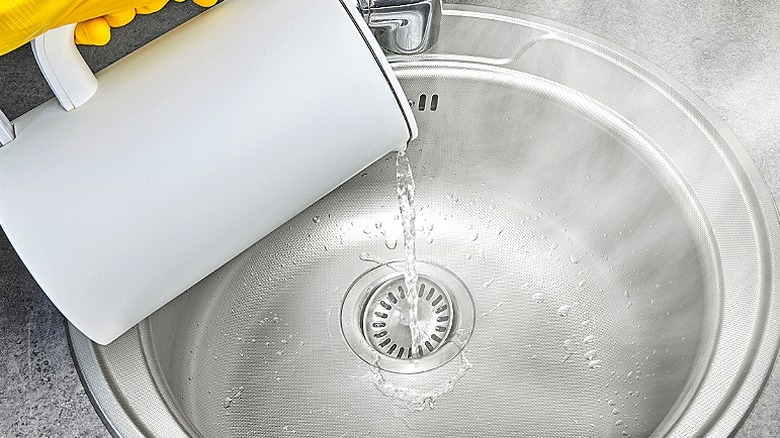
Even if you have immense faith in the gritty texture of salt and think it can clear out clogs, know that you'll need to dump in a good amount to make a dent – that is, not a tablespoon, but at least half a cup.
And if you're weighing the cost of a home remedy versus calling a professional, know that regular table salt won't be as effective as high-end crystalized salt, which is comparatively more expensive. Plus, for the reasons noted, salt would be pretty much useless against any significant buildup. So, in the end, this method won't make much sense if you're trying to clear out the clog in a budget-friendly manner.
It also won't do much as a purported hack to stop sink odor in the long run (since salt can't take care of the root cause). Additionally, you should avoid knowingly pouring in large amounts of solid particles down a drain because they can form a barrier of their own and consequently worsen a clog.
Moreover, the other element of this hack — boiling water – is a no-go as well, especially if you have a porcelain sink. This is because the high temperature could lead to cracks. So, you'd have to possibly foot expensive repair and/or replacement bills, the exact opposite of what you were hoping to do (i.e., save money).
As for PVC pipes, they may also not be able to bear the brunt of boiling water and wear out faster. Consider that water's boiling point is 212 degrees Fahrenheit; PVC's maximum operating or use temperature is 140 degrees F. A leaking or split pipe? That will only add to the overall bill, too.