

Use This Landscaping Staple To Keep Fungus Gnats Away From Your Plants
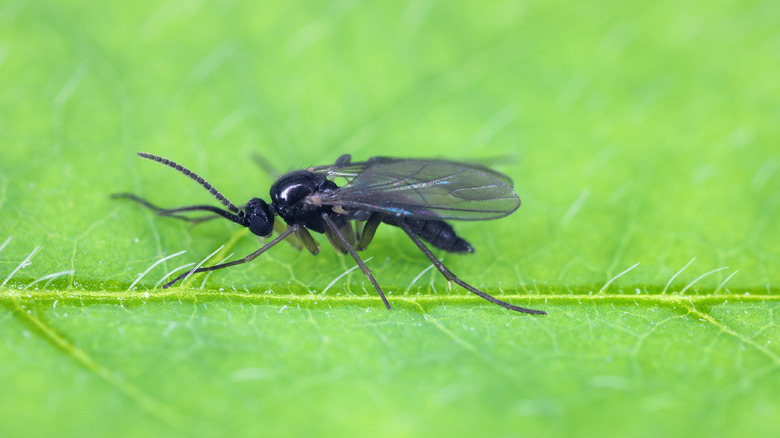
Sooner or later in your gardening life, you'll likely face the dilemma of fungus gnats and how to get rid of them. Wilting plants have numerous causes, but if you've ruled out watering and soil issues, it's possible you have a fungus gnat problem. In fact, you may be seeing more gnats than usual, especially if you live in a warm, humid climate. Adult fungus gnats are annoying, but not destructive to plants. Females lay eggs in moist soil with organic matter because that's what larvae eat when they hatch. However, the larvae will also nibble on plant roots to the point where the plant is damaged or killed. The gnats have a fast lifecycle in which multiple generations of larvae can emerge annually. You may be able to stop those generations with something that's likely already around your home — sand.
Sometimes it's effective to reduce moisture and organic matter in and around your pots. In fact, overwatering is the houseplant mistake that may be attracting gnats into your home. But you may need stronger measures to rid yourself of the gnats. The idea behind the sand method is to prevent females from laying their eggs by placing sand as a barrier on top of their normal egg-laying area. You're breaking the cycle; if no eggs are laid, no root-chomping larvae can emerge.
Use sand to block fungus gnats from laying eggs in your soil
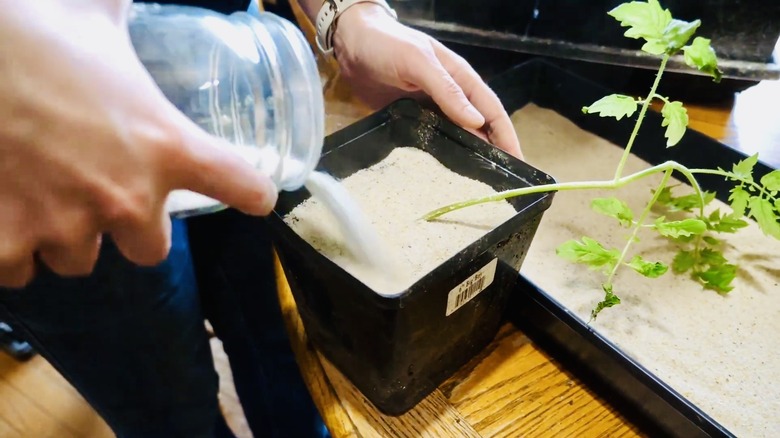
To implement the sand method, put down a quarter-to-half-inch layer of coarse horticultural or builder's sand (not the fine play sand that goes in children's sandboxes) on top of dry soil. It's important to ensure no soil is visible so no more fungus gnats can sneak in. As an extra measure to keep soil well-hidden from gnats, you can tamp down the soil in pots already disturbed by gnat larvae to ensure the sand can smoothly cover every nook and cranny.
Because fungus gnats are attracted to moisture, you can also place a layer of sand in a tray beneath the pots, pressing the sand-topped pots firmly into the sandy tray to keep the gnats from accessing the drainage holes at the bottom. When it's time to water plants, simply water from the top and let the water flow through the sand, then re-cover any areas of soil that become exposed in the process.
In addition to using sand for existing plants, you can also place it on top of seeds you've just sown. While no known scientific studies have been conducted on the sand technique, a 2014 study published in the American Society for Horticultural Science using glass aggregate suggests other materials beyond sand can be used. Some gardeners have mentioned gravel and perlite as alternatives.