

The Antique Chinese Porcelain Jar Worth Millions That Collectors Dream Of Finding
Incredible finds are every collector's dream. And those who collect antique Chinese porcelain may wait a long time, or even a lifetime, for a piece worthy of awe. Some collectors dream of finding a piece like the 16th-century Wucai 'Fish' Jar and Cover that sold at Christie's for 27.4 million dollars in 2017. One of the key features that made this Ming Dynasty-era jar so popular as a collector's item, however, was its link to the Jiajing emperor. Similar jars are on display in museums for the masses. A humble collector might only dream of getting their hands on these coveted pieces of Chinese porcelain.
Wucai refers to a specific color palette that developed during the Ming Dynasty. Despite meaning "five color ware," the palette primarily featured red, green, and yellow on jars, vases, and other porcelain wares. The outlines of the designs were in a dark blue underglaze, and the porcelain itself was white, for a total of five colors. To achieve this range of colors in one piece, the porcelain would be fired twice: a blue underglaze as the base with red, yellow, and green enamels on top as an overglaze. Many examples of wucai porcelain on view in museums today and for sale at auction houses are the result of commissions by emperors during the Ming Dynasty, including Jiajing, Longqing, and Wanli. Unlike some valuable vintage porcelain worth looking out for, wucai porcelain has marks denoting dynasties.
How to identify wucai porcelain and other Chinese porcelain
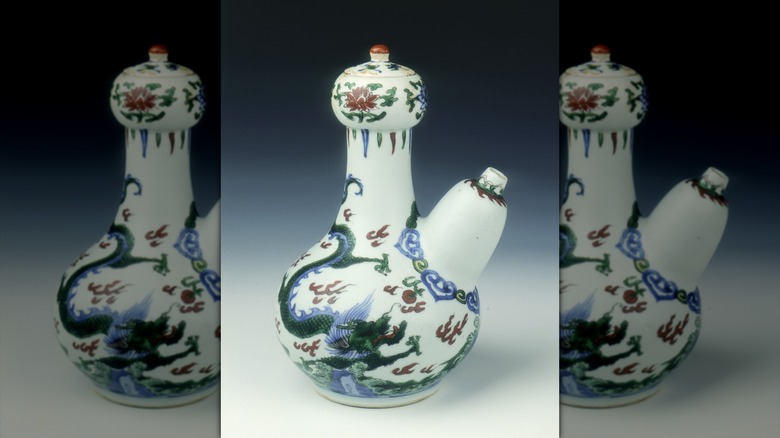
If you suspect you found a piece of wucai porcelain, there are a few ways to begin verifying it. Although the rare, million-dollar example of wucai porcelain sold at Christie's features a design highlighting fish, not all wucai porcelain used that same motif. Other examples from the same period featured the natural world, with flowers and plants, or the mythological world, showcasing dragons and phoenixes. There is greater variation in the wucai style, with more shades of green used in pieces made specifically during the Qing Dynasty. But, of course, wucai porcelain was created during several dynasties, so while you'd be lucky to score a Qing Dynasty bowl style at the thrift store, that does not mean it is a rare wucai piece.
There are many different types of valuable porcelain from China you can thrift. Not all of them will be as exhilarating as a once-in-a-lifetime wucai jar. Some of the most common porcelain found at thrift stores or estate sales are pieces produced after the 1800s, when a great deal of porcelain was exported to Europe from China. And most later pieces of Chinese porcelain, while still exquisite in style, color, and design, are less rare due to market saturation. Rather than being excavated during an archaeological dig, most of these pieces have been traded throughout Europe and beyond for over 100 years. Even so, it is always worth having a dream as a collector, and the Wucai 'Fish' Jar and Cover might be one of the biggest fish of them all.