

Everyone Owned It In The '50s — The Valuable Utensil Set That Leaves Collectors In Awe
Most people walk right past old silverware at the thrift store, yet if you spot an ornate floral pattern with "Wallace" stamped on the back, you may have found one of the most sought-after sterling flatware patterns ever made. Introduced in 1941, Wallace's Grande Baroque pattern is highly collectible, with complete sets often selling for thousands of dollars.
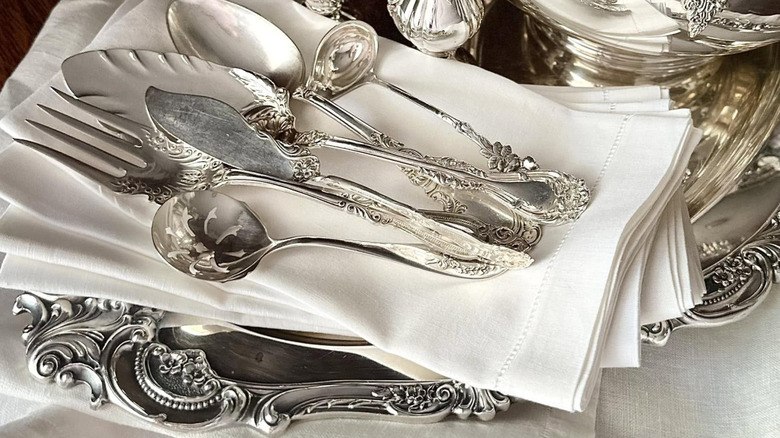
Wallace's history stretches back to 1835, when founder Robert Wallace opened a silver shop in Connecticut. The company later became one of America's best-known sterling silver manufacturers before the Wallace brand was eventually acquired by Lifetime Brands. The ionic Grande Baroque pattern overflows with sculpted flowers, curling leaves, and other dramatic Baroque details. What sets it apart from other silverware is that it is three dimensional. Grande Baroque was created by designer William Warren, and it was the fourth in a six-part pattern release marketed as the "Third Dimension Beauty collection." The name refers to the way that the design is embedded in the front, the back, and profile of each piece. The modeling also carries right down into the spoon bowls and fork tines rather than stopping at the handle.
A 95-piece service weighing 115.96 troy ounces sold for $3,120, drawing seven bids despite oxidation on a couple of knife handles. A smaller 56-piece service for 12, weighing 65.13 troy ounces, unmonogrammed and still in its wood case, sold at auction for $1,708. Single pieces are also top sellers, as a set of unpolished forks can sell for over $500.
What to look for when thrifting for Grande Baroque
If you're looking for Grande Baroque utensils, keep in mind that the pattern is still in production. But even newer sets are worth something, and that's because sterling silver is more valuable than most people assume. Sterling is an alloy made of 92.5% pure silver and 7.5% other metals, usually copper, making it durable enough for everyday use while retaining its precious-metal value. That means even badly worn or damaged sterling pieces have intrinsic worth because they can be sold for their silver "melt value," the value of the silver they contain if melted down and refined.
The easiest way to identify genuine Wallace Grande Baroque flatware is by checking the back of each piece for the manufacturer's marks. The most common mark on sterling pieces is "Wallace Sterling" — which means it is solid "925" silver. You may also find "sterling" stamped by itself or alongside the Wallace name, which confirms the piece is solid sterling silver rather than silver plate.
You can also look for the Wallace hallmark, which varies slightly by production era but typically includes the Wallace name or logo. Silver tones are trending for 2026, and baroque and ornate mid-century flatware is having a moment generally. That makes Wallace flatware worth the search. So the next time you pass a bin of mismatched silverware, don't ignore it, because you could be looking at one of the most valuable flatware patterns out there.