

It Had Its Moment In The '80s- Now It's The Rug We Want In Our Homes
During the 1980s, consumers ditched the minimalism of modern interior design and embraced what we now call "maximalism," using bold decorating styles filled with ornate furniture, layered patterns, and Asian-inspired accents. Chinoiserie rugs (which literally means "Chinese-esqe") fit perfectly into that aesthetic. While some 1980s aesthetics are strange and therefore best left in the past, others are being reimagined for today's homes. Chinoiserie is perfectly positioned for a comeback among homeowners who want rooms with more personality and character.
Rather than filling a room with matching Asian-inspired furniture and accessories, today's designers are using chinoiserie more selectively. For example a single rug paired with chinoiserie wallpaper can refresh almost any room. Chinoiserie rugs fit comfortably with lacquered and natural wood and meshes with contemporary furniture. The detailed patterns featured on chinoiserie rugs can serve as a visual anchor for the whole room, adding excitement to otherwise bland spaces. It's yet another retro trend bringing character back to home decor. In fact, many homeowners are using a chinoiserie rug to incorporate the grandmillennial style into the kitchen. If you don't want your home to feel like a time capsule, the grandmillennial approach offers a good blueprint: start with one traditional statement piece and balance it with simpler, modern elements.
How To style Chinoiserie without looking stuck in the '80s
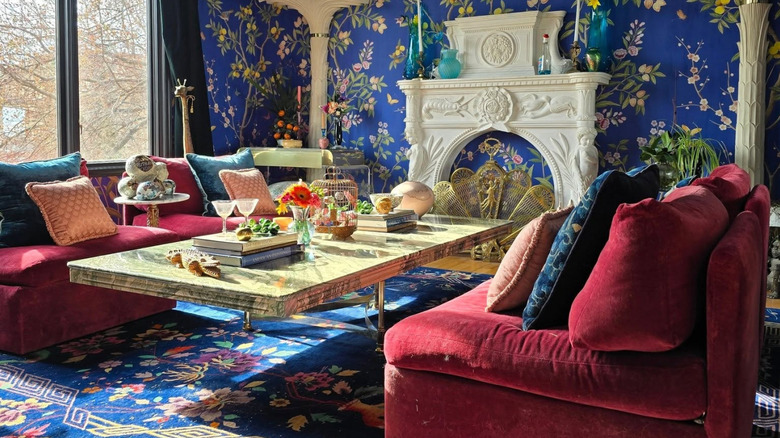
The easiest way to modernize a chinoiserie rug is to let it be the statement piece. Keeping your living room colors monochromatic, for example, draws the eye to the patterns on the rug. Pair it with neutral upholstery, natural wood furniture, linen fabrics, and simple lighting rather than competing prints. Blue-and-white chinoiserie rugs work particularly well with oak and walnut floors. The softer floral motifs found on many chinoiserie rugs also fit naturally into cottagecore interiors. The rich symbolism of vintage Chinese rugs, which often feature dragons, lotus blossoms, and pagodas, works well in maximalist or bohemian spaces because they layer seamlessly with other textures. Some homeowners have found a vintage Chinese art deco rug and used it to create a maximalist vibe.
Vintage rugs often have another advantage: they're typically made from wool or other natural fibers, giving them a depth and durability that's difficult to replicate with many mass-produced alternatives. This makes them rewarding thrift store finds. Depending on their age, condition, maker, and fiber content, well-preserved examples may resell for hundreds of dollars on the secondary market. A hand-knotted blue vintage rug sold for $500, while a 1960s rug featuring a dragon sold for over $900.