

Lawn Mowers Look Nothing Like They Used To

Perhaps it all started with a simple discussion of the best way to mow a lawn on a British country estate. Up until the early 19th century, lawn mowing was accomplished primarily by grazing animals like sheep and by using scythes wielded by paid laborers. The first true lawn mower was a big improvement on sheep and scythes, but its resemblance to today's power mowers stops at the handle used to push it.
We don't know if engineer Edwin Beard Budding was mulling over the lawn-mowing issue as he worked on other inventions. Still, we do know that a cloth-cutting mechanism (called a cross-cutter) with a bladed reel that Budding saw at a cloth mill inspired him to apply the same technology to the mower he invented in 1830 in Gloucestershire, England. Budding had sporting facilities with playing fields in mind for his new invention.
If we compare today's push reel mowers to the earliest Budding mowers, we discover they are surprisingly unchanged. A significant change, though, is the weight of the early reel mower, which had an iron body and wheels, making it so hard to push that a handle was introduced for the front of the mower so a human (or later, an animal) could pull it while another person pushed it. When mowers were configured to be pulled by animals like horses, soft leather shoes for the animals became part of the process. They were placed on the animal's hooves to prevent hoof prints in the lawn. Clearly, Budding's behemoth machines were quite different from today's power mowers. Let's take a look at the evolution of lawn mowers.
The evolution of lawn mowers
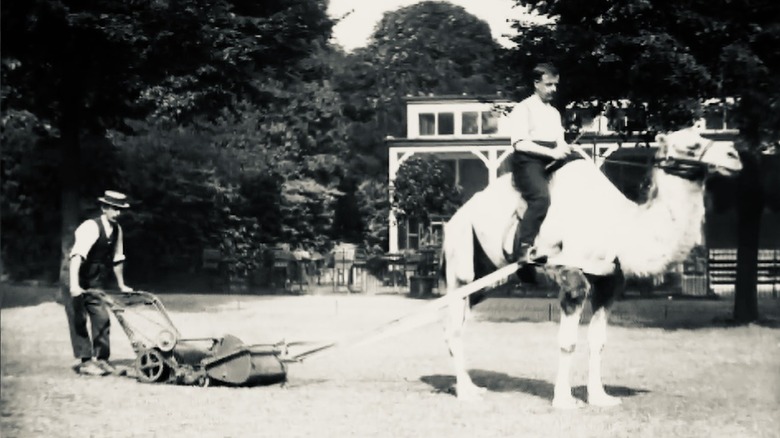
While today's decisions around lawn mowers are largely limited to choosing between a gas versus an electric lawn mower, homeowners in the early 20th century might choose from a reel, steam, or gas mower. The first significant advancement beyond Budding's innovation was the chain-driven mower in 1859. It was quieter and lighter, having shed heavy iron parts, and popular enough to sell a million units. The steam-powered riding mower arrived in 1893. The machine needed hours to generate sufficient steam, and like Budding's model, was exceedingly heavy.
The invention of automobiles and the internal-combustion engine influenced lawn mower design, with the introduction of a gas-powered mower 10 years after the patent for the first automobile in 1886. The connection between auto and lawn mower was cemented when auto manufacturer Ransom E. Olds (think Oldsmobile) created Ideal Power Lawn Mower Co. to make internal-combustion mowers. Milestones between early gas-powered mowers and today's machines include corded electric mowers in the 1920s; the zero-turn mower, the drive wheel which could turn 360 degrees, in 1955; self-propelled mowers in 1969; cordless, battery-powered mowers in 1973; and lithium-battery models in the 21st century.
Today, we can boast of high-tech lawn mowers that can do a lot more than just cut grass. They're capable of cleaning perennial garden beds, bagging autumn leaves, trimming cover crops, and more. The newest innovation, the robotic lawn mower, alas, finally does away with the last vestige of Budding's reel mower — the handle for pushing.