

Add Some Texture: The Velvety Annual For Your Container Garden
We may receive a commission on purchases made from links.
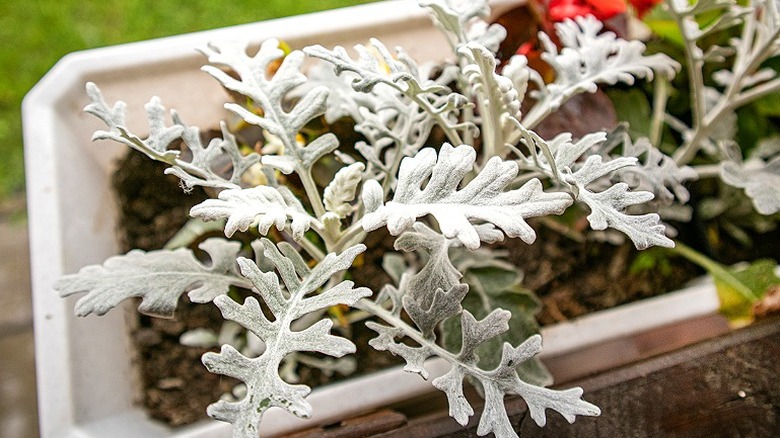
You don't need a dedicated garden or big backyard space to grow beautiful plants. With container gardening, any small space, even a small front stoop, can transform into a growing space. And there are hundreds of different plants you can choose from, too, each suitable to grow in a container or pot. Take, for instance, dusty miller (Jacobaea maritima), a beautiful subshrub often grown as an annual. Its ornamental, lance-shaped, silvery-white leaves bring a soft velvety texture to any space.
Dusty miller can grow 6 to 18 inches in height, and nearly a foot wide. It flowers as well. The flowers, however, are quite small and not very showy; in fact, gardeners often pinch them off so the plant's attractive foliage remains the main attraction throughout the season. Honestly, the dusty miller is an ideal pick if you're looking for beautiful plants to grow in your garden that aren't flowers. It also pairs beautifully with both silver-toned companions and brightly colored plants, creating eye-catching combinations, whether in containers or in the ground.
With its fuzzy texture, dusty miller is also naturally resistant to deer. What's more, you can even grow dusty miller as a perennial in your container garden if you live in the warmer USDA plant hardiness zones 7 through 10.
Growing dusty miller in a container garden
You can start dusty miller plants in your container garden either with seeds or with cuttings. Just keep in mind that growing dusty miller with seeds is a slow process. Nevertheless, you can start the seeds indoors by surface sowing seeds 10 to 15 weeks before the last frost date in your area, per the North Carolina State Extension. Note that to germinate, dusty miller seeds require light.
For propagation through stem cuttings, take them in early spring. When ready to plant, choose a well-draining container, and use a soil that has good drainage. For large containers, you can grow more than one dusty miller plant — just make sure to maintain a spacing of about 8 inches between them.
Choose a sunny spot, too. Even though the plant is tolerant of shade, if you grow it in too much shade, its foliage isn't going to pop as much. For fertilization, keep things light; fertilize only when the soil is poor (or at the time of planting). Use a slow-release fertilizer, like Osmocote Smart-Release Plant Food Plus.
Lastly, for pruning, while you don't need to prune dusty miller, you could do so to promote new growth in the coming spring. You may also want to prune if your plant becomes leggy, as well as cut away any leaves that turn yellow and take away from dusty miller's silvery-white look. If you do prune, do so in the fall or early winter. (Read about the "three D" rule to properly pruning your plants.)