

Be Warned: The Beautiful Rose Variety That May Attract Ticks To Your Yard
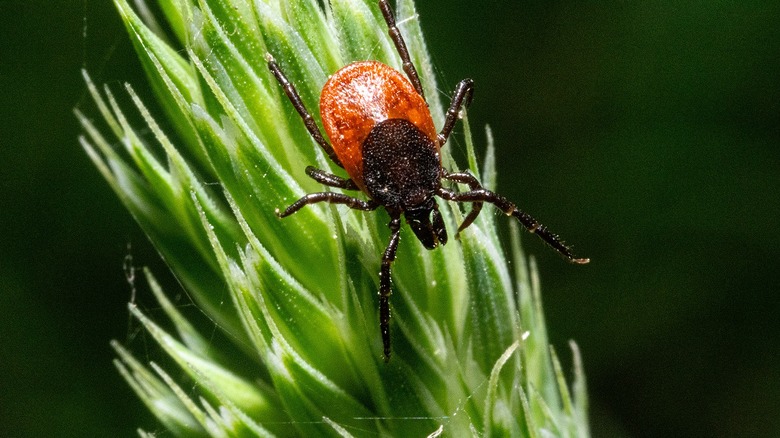
According to Terminix, Texas, California, Florida, Pennsylvania, and Georgia are the top five states with the worst tick problems. As a region, the northeastern United States also sees a lot of ticks. If you live in any of these areas, it's especially important to stay vigilant and aware of where ticks might be lurking in your yard; they can be drawn in by certain plants more than others. For instance, ticks tend to congregate near the dense thickets of the multiflora rose (Rosa multiflora). Moreover, a study published in the journal Parasites & Vectors found that the ticks that live near these plants tend to be more likely to carry the Lyme disease pathogen.
The multiflora rose bush is already an invasive garden threat in its own right. Native to Japan, China, and Korea, the plant made its way to the United States in the mid-19th century. Just like many invasive plants, the multiflora rose was first prized for its beauty, and it was actually cultivated as a "living fence."
A century later, though, and the multiflora rose was flagged as a potential threat. It grows in 41 states today, with 13 listing it as noxious or invasive, per the New York Invasive Species Information website. While these plants are lovely to look at, they're a risk to have in your yard — not only for their impact on native plants, but for the potential tick problem they could bring. (Ridding your yard of multiflora roses is just one of the ways to protect yourself and your home from ticks.)
Identifying the multiflora rose in your yard
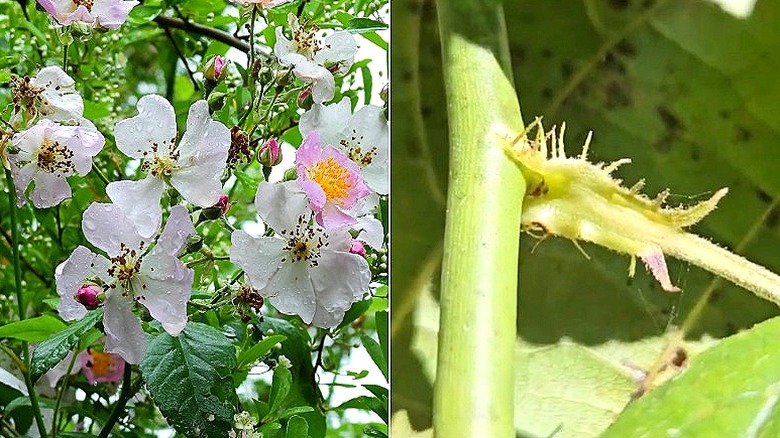
If you want to reduce your chance of attracting ticks to your backyard, it might be a good idea to remove any multiflora roses. To do so, you'll need to know how to identify them. According to Purdue Extension Forester Lenny Farlee, a multiflora rose has some specific telltales, including "alternate leaf arrangement" and "compound leaves, with oftentimes seven leaflets." It also has "very sharply hooked thorns," which Farlee notes can make them "almost impenetrable in terms of trying to get through the thickets that it forms."
The shrub can grow tall and wide, at least 10 feet high with a spread of 14 to 15 feet. However, multiflora rose can look like a state's native roses, too. To know its multiflora rose, you'll need to look for the plant's stipule (above right image). As Farlee explains, "... Another characteristic that can help us separate multiflora rose from our native roses is right at the base of the leaf. So we've got this little structure at the base of the leaf, which is a widening wing, called a stipule. And along the edge of the stipule ... we have little hairs projecting off away from [it]." So, if you find a stipule, there should be no doubt you've got a multiflora rose shrub growing.
That said, if you're still unsure of what you're dealing with, you can consult your county office or other plant professional to help you identify it. As for the ticks, getting rid of multiflora rose is one way to fight against them. At the same time, you could establish plants that keep ticks out of the yard, such as catnip, peppermint, rue, or sage.