

What's The Difference Between Growing Yams And Sweet Potatoes?
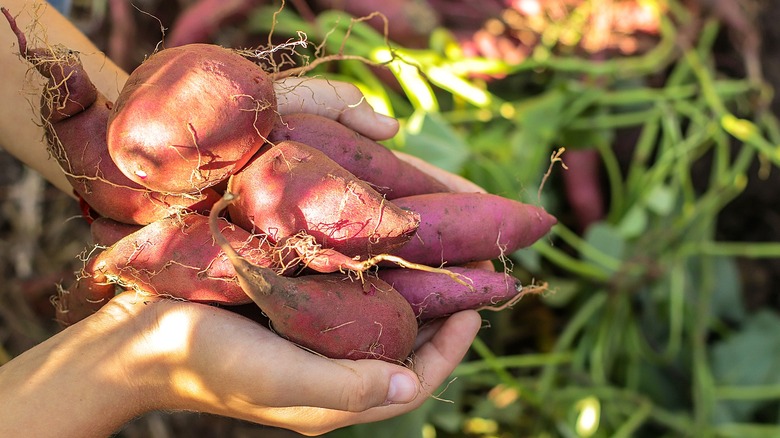
Ever have a fierce debate around a holiday dinner table about what that delicious orange mash was made of: sweet potatoes or yams? The more you dive into gardening, the more you gain knowledge about particular plants to settle such questions once and for all. As for this specific question, it turns out that sweet potatoes and yams require very different growing conditions, and if you knew where they could grow, you'd know that holiday mash was unlikely yams. That's because yams aren't grown in most regions of the United States due to their cultivation needs; sweet potatoes, meanwhile, are widely available root vegetables that love warm weather and often thrive in home gardens.
Both sweet potatoes and yams originate from warmer regions than the U.S., but, as said, only the sweet potato (Ipomoea batatas) can grow here. Sweet potatoes actually belong to the same family as morning glory vines and their ability to keep when they're dried make the root vegetables an essential crop that belongs in every survival garden.
Yams (Dioscoreaceae), on the other hand, are tropical vining plants native to parts of Asia and West Africa. Their edible parts are tubers rather than roots, and they need hot and humid tropical or subtropical conditions to grow, which is why they're one of the most popular and important crops grown in Puerto Rico. Also, while it's possible to get up to 10 edible roots from a single sweet potato plant, yams tend to produce smaller crops that only amount to around half of that yield.
Sweet potatoes need warm weather and light soil to grow
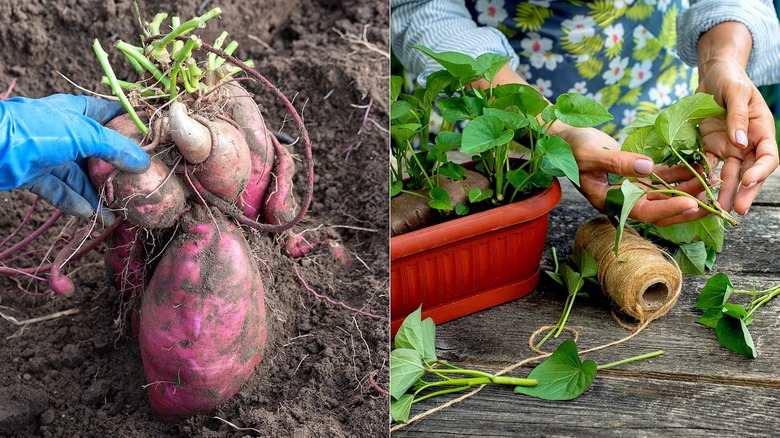
Sweet potatoes are usually grown as annuals in the warm seasons, but are technically perennials that can stay outside all year in zones 9 through 11. You can grow sweet potatoes in containers for year-round harvests when it's warm enough that the soil stays above 65 degrees Fahrenheit. If you're in a region that's not known to be hot or you start them early, placing a black plastic covering over the crop in the early stages may help you obtain the necessary warmth.
To get the sweet potatoes established, you'll want to obtain some sprouts known as "slips" (right image above), which you can clip from the previous year's crops, buy from online sources, or even grow yourself by planting sweet potatoes from the grocery store. Slips are the best starters for sweet potatoes since they take root at the nodes in their long vines, and these roots become the starchy vegetable we know and love.
The best soil for sweet potatoes is on the sandy side, but most importantly it should drain well and not be too heavy or rich in clay. Make sure one of the nodes stays above the soil when you plant the slips, and leave at least 6 inches of space between them (is possible, give them a foot).
For container gardening, plant slips from "bush" cultivars that stay more compact into a large pot filled with light growing mix. If you have a larger garden to work with, planting the sweet potatoes on raised ridges that measure 8 or 10 inches high can help their soil stay warm and prevent them from getting waterlogged. The roots can be ready to harvest anywhere between 90 and 120 days of growth.
Yams require tropical humidity and some types are invasive
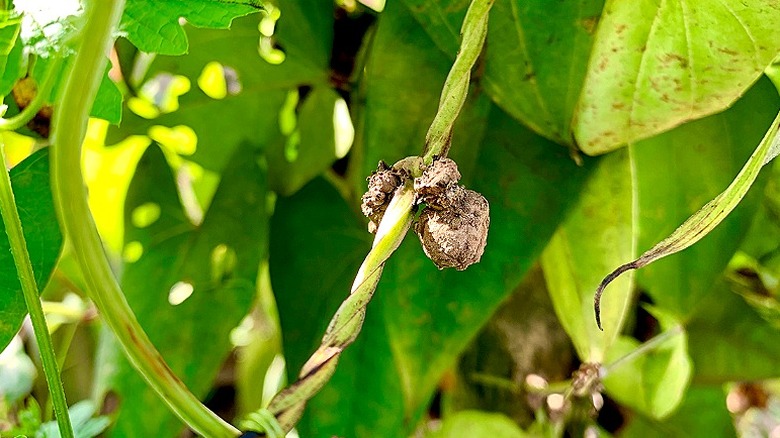
The type of sweet potatoes that has soft, orange flesh is sometimes labeled as a "yam," but actual yam crops are hard to cultivate outside of the tropical climates of the Caribbean, Asia, or West Africa (for example, according to the Carnegie Museum of Natural History, West Africa accounts for 95% of the world's yam production). Though yams may be among the perfect plants to grow if you live in a tropical environment, your best chance at tasting a yam in the U.S. is to shop at an Asian, Latin American, or Caribbean grocery market.
Note that some types of yams that have been introduced to the United States, like the water yam (Dioscorea alata), do grow in zones 9 through 11, but are still considered invasive in some states, specifically, Alabama, Florida, and Georgia. The rapid growth habit of some yam plants has been shown to endanger native plant populations in areas like these.
Outside of a greenhouse, it'd be difficult to replicate the moist, shady conditions of a tropical or subtropical forest. Yams thrive on abundant humidity. If you could grow them, they'd be a resilient plant, tolerating dry spells and powerful winds, given that their tubers grow underground.
Considering their native climate, it's unsurprising that yams are sensitive to the cold. Note that even when the plants grow in warm southeastern states, they often don't produce fruit. Gardeners who do attempt yam growing tend to plant cut sections of the tuber that have been dried first.