

Easier Than A Screwdriver: The Better Tool For Removing Weeds From Gravel Driveways
We may receive a commission on purchases made from links.
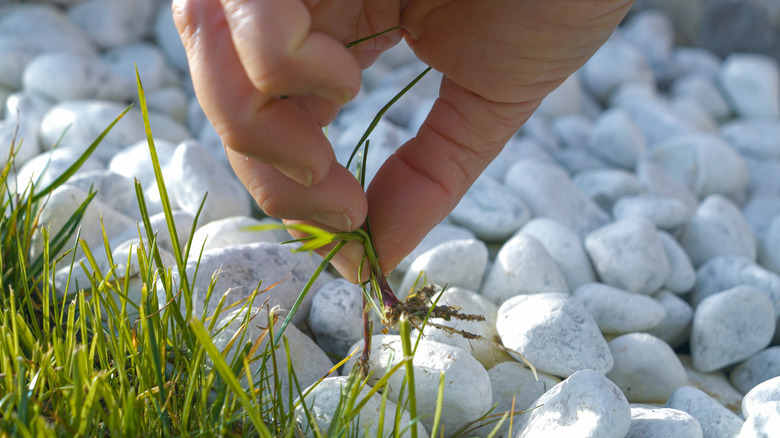
Nothing ruins the look of a neat gravel driveway faster than weeds pushing through the loose stones. Weeds can appear quickly in gravel, and even though they seem easy to remove, it is not always the case. Sure, you could use your hands or a screwdriver to pull the weeds out. The problem, though, is that many weeds break off at the surface this way. This leaves their roots behind, which can again sprout into new weedy plants. Don't worry, though! That is exactly where a dedicated weed removal tool like the Husky Double Injection Stainless Steel Hand Weeder can help.
Unlike a traditional screwdriver, the Husky hand weeder has a grooved, forked tip that is designed to reach weeds at their roots. Its head is also made of rust-resistant stainless steel. Plus, it features an ergonomic molded handle with a nonslip grip. That combination makes it a practical tool for tackling weeds hidden between wet, compact soil and gravel in driveways. In terms of size, the weeder measures about 6 ¼ inches. This means it is a kneel-down tool, and if you have any back issues, you might want to look into some other types of weeder tools.
Its buyer feedback is highly positive, too. Customers describe it as sturdy and effective, and consistently praise its sharp forked tip. In fact, one reviewer even said that this weeder is the only tool worth using to dig dandelions out. Not all the feedback is positive, though! For instance, some buyers mentioned that the tool does not work on all weeds. So, make sure you look into some other helpful weeding tools as well before making the purchase.
How to use the Husky hand weeder tool in a gravel driveway
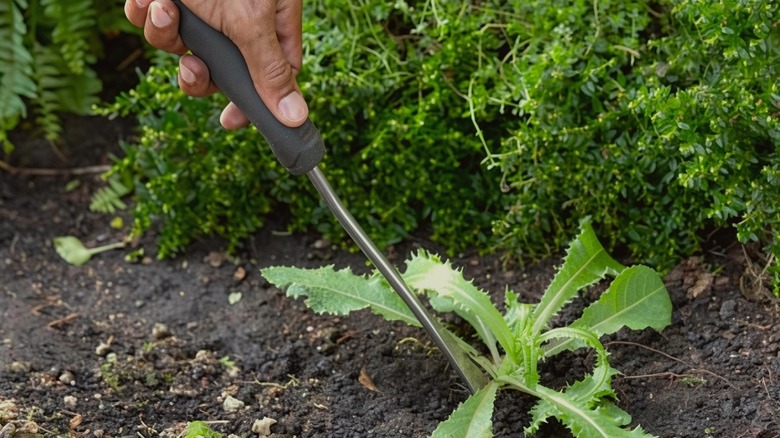
Using a hand weeder on a gravel surface is more about technique than brute force. So, don't just push the weeder into the gravel. Instead, insert it carefully at an angle beside the weed so the fork slides beneath the crown at a point where the stem meets the root system. Then push the handle downward and use the ground as a fulcrum to lift the weed. Try your best to loosen the weed and pull out as much of the root as possible in one steady motion instead of snapping it off partway down. If you leave any roots behind, they might sprout again. This is why pulling the leaves of the weeds alone never works. Most weeds that grow in gravel driveways, such as dandelions, chickweed, and plantain, store the energy they need for regrowth in their root system. So, even if you pull their stems or leaves out, they can still grow back.
It is also important to keep in mind here that not every weed that grows in gravel driveways behaves the same way. Shallow-rooted weeds like crabgrass lift out quickly. However, deep-rooted weeds like dandelions need a bit of patience, and you should loosen the gravel around these weeds first and then work the forked tip in from two or three different angles before applying upward pressure. If you force a single hard pull on a deep-rooted weed, it can easily snap it below the crown, leaving behind a root system that is ready to sprout again.
Lastly, don't just sit back once the weeds are out. Instead, take some measures to prevent weeds from growing in gravel.