

The Sculptural Evergreen Tree That Prevents Erosion And Creates Backyard Privacy
We may receive a commission on purchases made from links.
Backyards should feel safe and private, places where you can sit and relax without worrying about passing people or cars. Sure, a fence can help, but it can also make the space feel blocked, limited, and, well, fenced-in. That is where privacy plants come in. They create a natural screen that makes a garden or patio area feel organically secluded while also bringing greenery, seasonal color, and texture that a plain fence just cannot provide. Now, when it comes to natural privacy screens, most people use arborvitae or cedar. However, if you want something with a bit more personality that is also good for your yard's health, you should definitely check out the Monterey cypress (Hesperocyparis macrocarpa).
The Monterey cypress is an evergreen conifer that is known for its distinct appearance, fast growth, and general low maintenance. The tree can live for nearly 200 to 300 years. However, what makes the Monterey cypress really appealing is its sculptural growth habit. The tree, when young, has a pyramidal shape, but as it ages, its crown becomes wider and flatter, and its branches become contorted, giving the tree a dramatic, windswept appearance. Better yet? The Monterey cypress is one of those trees that can reduce soil erosion while also beautifying your yard. That's thanks to an extensive root system that holds the soil and absorbs excess moisture, anchoring the earth.
In terms of size, the Monterey cypress grows about 40 feet tall, though it can get up to about 80 feet. While beginning somewhat narrow, they also expand as they mature, with a spread of up to 30 or 40 feet. So, if you have a smaller yard, this tree might not be the right choice. It is also important to note here that the Monterey cypress is only hardy in USDA zones 7 through 10; if you live outside these zones, you will probably need to find some other fast-growing trees to build a natural privacy screen in your yard. They also thrive in coastal areas, but can still do fine more inland.
How to grow the Monterey cypress for backyard privacy
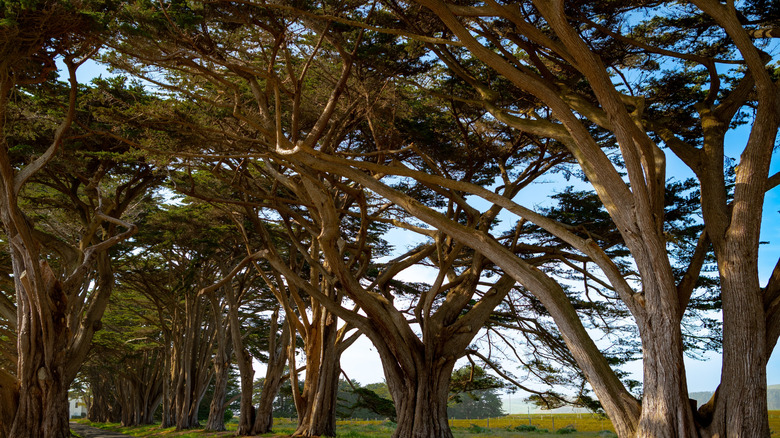
If your goal is to build a natural privacy screen using the Monterey cypress, you will need to plant multiple trees around the boundary of your yard. However, it must be done with a proper plan. Considering how much these trees spread as they age, you must make sure that you space them correctly. If you plant many of them together in proximity, they will compete for space and light. For best results, plant the Monterey cypress about 13 feet apart. If you're intending to use it as a small hedge to add a bit of privacy to your yard, keep in mind that you will need to prune it regularly. Otherwise, little to no pruning is necessary, but make sure to remember the three Cs rule when pruning plants if you do intend to maintain a smaller size.
Although it only does well in Zones 7 through 10, the Monterey cypress is pretty resilient once it's planted. It prefers full sun, but can tolerate partial shade, just not deep shade — it can lose its leaves if it doesn't receive enough sunlight. Besides light, these trees are also fine with just about any soil condition, though their preference is for slightly acidic to neutral soil. There are many home-based soil testing kits that you can use to check the pH of your soil at home; the Luster Leaf Rapitest Soil Test Kit should do the trick if you want to really optimize your growing conditions, but it isn't absolutely necessary.
As for watering and fertilizing, it's best to keep things light. Like many trees, the first couple of seasons require more consistent watering, so it's best to water a Monterey cypress weekly and deeply while it's young. The tree is very drought-tolerant once established, though. It's generally low-maintenance, but if its growth is slow, you can apply a slow-release fertilizer in early spring for a boost. Just make sure that you follow all label instructions.
Lastly, while Monterey cypress trees are not included on California's list of banned plants, they do have a limited invasiveness rating in some parts of the state. You can reach out to the California Invasive Plant Council if you live in the state and have any concerns or questions.