

Don't Mistake It For A Tarantula: How To Identify Mouse Spiders In Your Home Or Yard
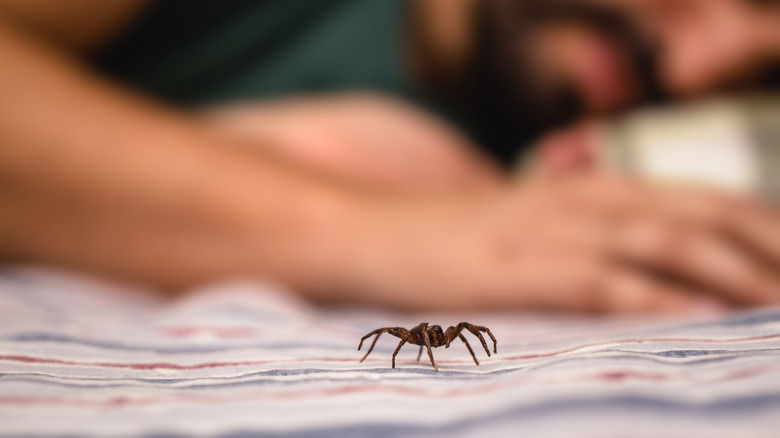
Many people find spiders spooky and freak out when one is found inside a house, no matter the size or the species. But not all spiders are dangerous — in fact, there are many beneficial spiders you may not want to kill in your home. However, it's hard to know which spider you're facing down in the middle of the night unless you understand how to identify them. There's one spider, for example, that may look like a miniature tarantula at first glance, but is really something entirely different: the mouse spider (Scotophaeus blackwalli). While tarantulas can inflict a painful bite, mouse spiders are harmless to humans and pets.
The common name "mouse spider" is most often used to refer to a group found in Australia (Missulena spp.). S. blackwalli is not actually closely related to this genus; it gets its common name from the shiny fuzz on its body, which looks similar to a mouse's fur, and its habit of running in short bursts along the edge of a room like a mouse. It's certainly not one of the most common spiders you may see in your home, but if you live on the West Coast, it's a possibility. They are native to parts of Europe and have been introduced to the United States. Despite seemingly similar behavior and appearance, mouse spiders and tarantulas are very different, and you can easily tell which is which. You don't even have to get too close to be able to do so.
How to tell a mouse spider from a tarantula in your home
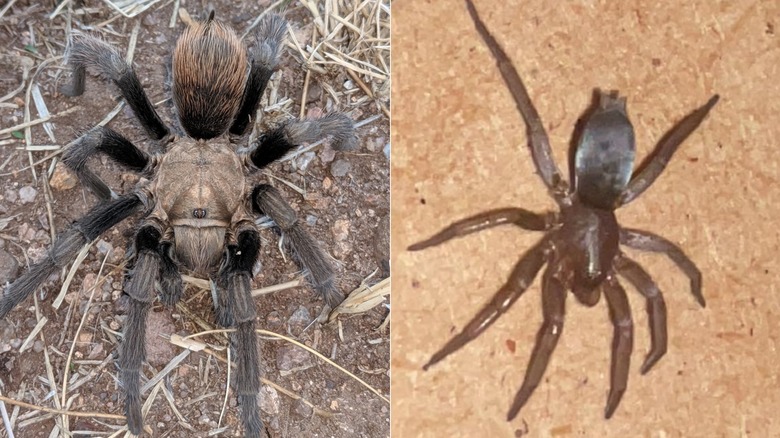
These two spiders do share some similarities. Both have a layer of fuzz, and most tarantulas dwell on the ground like mouse spiders. Depending on the species of tarantula, the color can also be similar – shades of brown. Additionally, you won't see either of them in a web. Mouse spiders don't make any at all, while tarantulas create nests out of their webbing on the ground, usually inside of a burrow.
However, that is where the similarities stop. One of the first ways to tell these two apart is by the location. Mouse spiders are an introduced species currently only found in Hawaii and along the Pacific Coast, which includes California, Washington, and Oregon. Tarantulas, though native to North America, are limited in their distribution. They are found in about 13 states, primarily in the Southwest and California. Unless you're in this Pacific-side state, you can probably pick out which one you saw just based on your location. However, if you happen to be where they both live, there are some other ways to tell them apart.
Tarantulas tend to be bigger, at least several inches in length. In comparison, mouse spiders only reach half an inch at most. Their speed is different, too. Tarantulas are usually not in any rush. They tend to stay on the ground and walk slowly around. Mouse spiders are fast and may be seen scurrying along walls and ceilings, pausing, then scurrying again. Neither is likely to bite you, though it is possible. A tarantula's bite feels similar to a bee sting, but both tarantula and mouse spider venom is harmless unless you are allergic.
Other spiders that look similar to mouse spiders
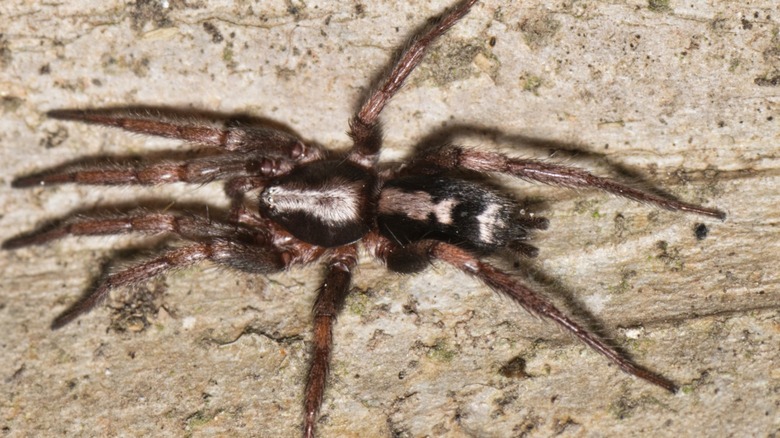
Although mouse spiders look pretty different from tarantulas, they can be easily confused with other species, such as stone (Drassodes spp.) and parson spiders (Herpyllus ecclesiasticus). They are all in the same family, classified as nocturnal ground spiders that are relatively quick and don't use webs. They can also be shades of brown. The parson spider is the easiest to identify and rule out. The colors on the head and abdomen can look similar, but what really makes it distinct is the white line that runs down its back. This is where they get their name, as it looks somewhat like the collar of a clergyman.
Drassodes are a little harder to tell apart. They grow some fuzz, but they don't look velvety. They tend to be pretty muted colors. They may also have black markings on the body. Depending on the species, Drassodes will potentially be identifiable because of their thinner legs and more oval middle eyes. Meanwhile, in mouse spiders, the legs are thicker and shorter, and the eyes are round. Thankfully, both are harmless to humans, unlike the two spiders you absolutely do not want to find in your garden or yard: brown recluses and black widows. This means you don't have to freak out much if you encounter one of these small brown spiders, even if you can't quite identify what it is.