

Check Your State Laws Before You Decide To Fill In Your Swimming Pool

Diving into pool ownership can sound like fun in the sun. That's probably why roughly 8% of U.S. households have one in their yard (per RenoSys). But between the cost of installation, continued maintenance, and the safety concerns, many homeowners find themselves wishing they had never waded in. And because an in-ground pool can eat up a fair amount of square footage in your yard, there's a growing trend toward just filling it in.
If you're ready to ditch your pool, you have a few options. A partial removal means draining out the water and filling the structure left behind. In a full removal, every piece is demolished and hauled away. And while a total pool removal can cost between $15,000 and $20,000 versus the $5,000 to $12,000 figure for a partial removal, it may pay off in the long run. In most states, a filled-in pool is considered a material fact that must be disclosed to potential buyers, some of whom will see it as a negative.
While specific laws and regulations can vary depending on where you live — you can check local property disclosure laws, or consult with a real estate agent — generally you're not allowed to build over a filled-in pool. That means you can't use that space to add square footage to the home or house an additional structure. Even if you weren't planning a backyard expansion, if could become an issue should you decide to put your house on the market.
How to choose between filling and removing your pool
For those that only use their pool a few months out of the year, there's a strong case to be made for a removal. In addition to the cost of installing, you have to splash out for routine cleaning. Yes, it can get icky if you don't clean your pool. Plus, there's preparing it each season, the extra cost in utilities to run the pump, and the price for any repairs. And given that more than 350 children on average drown each year, companies tend to charge higher homeowners insurance rates for properties with pools.
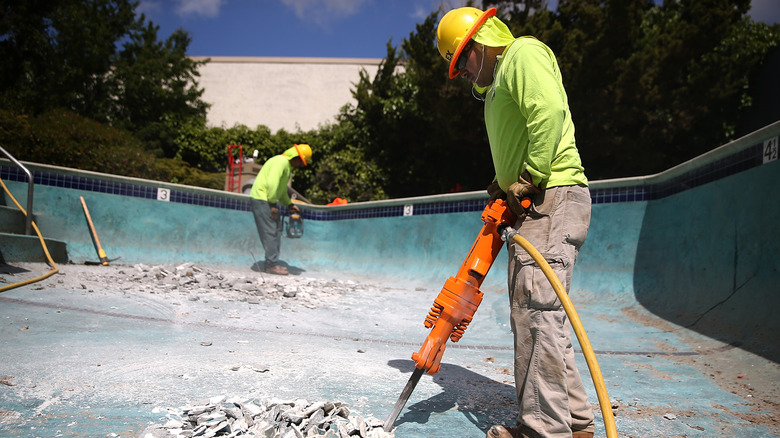
However, getting rid of your pool can also drain your savings. Though cost isn't the only factor to consider. A partial removal requires you to drill drainage holes at the bottom and break up the top layer. The resulting rubble is then left at the bottom and covered. From there, you can turn your pool into a garden or entertaining space. While it can technically be a DIY job for handy types, it requires careful attention. Since the soil will settle over time, you'll want to tamp it down and likely overfill, so you're not left with a sagging section of your lawn.
A full removal usually requires calling in professionals. You'll need to demolish every piece of the pool and dispose of it properly. Either option requires acquiring a demolition permit, a grading permit, or both, so do your homework before diving in.