

Not Vinegar: Here's A Better Solution For Removing Moss From Concrete Pavers
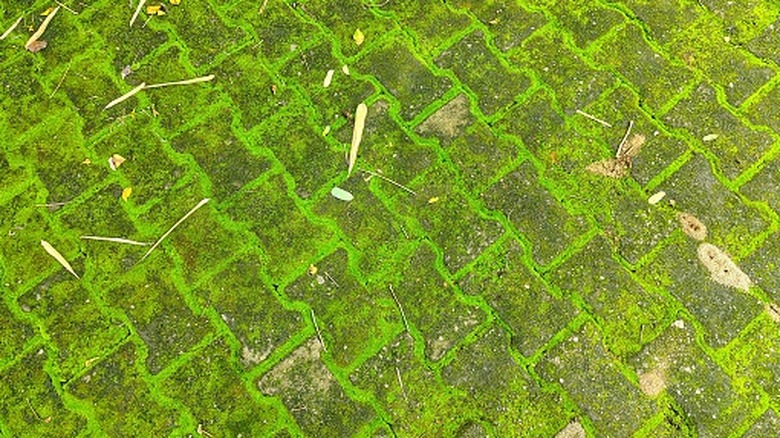
In some circumstances, there's some charm to greenery taking over our outdoor spaces. For example, the idea of moss growing in between concrete pavers is somewhat appealing, in theory. But more often than not, it doesn't look like the entryway to a hobbit house in the Shire or the steps leading to a medieval castle. Instead, moss starts to grow all over the place, giving it a much messier look. It comes with dirt, algae, and weeds, and slowly takes over the pavers themselves. So if your yard is looking unkept instead of magical, we have the solution for you. Not some DIY mixture, but pressure washers.
You might have heard of tons of hacks to remove moss from your driveway and sidewalk using vinegar or bleach. But with chemical solutions like these, you still need to come in after the moss has died to scrape and scrub it off the pavers and grout. If you'd like to avoid this step and instead tackle mossy driveway pavers in one swift go, a pressure washer is your friend. This should effectively remove not just moss, but also algae, mildew, and mold. Plus, it's super satisfying and provides instant results.
Still, there are common mistakes that nearly everyone makes when pressure washing. But if it's not used correctly, a pressure washer can cause some damage to your patio flooring. While it can be particularly tricky on tiles and pavers, pressure washing is safer on concrete, which is why it's perfect for those pavers. But even then, you'll have to be delicate and careful; use the right type of nozzle in order to remove moss without causing any damage.
How to pressure wash mossy concrete pavers
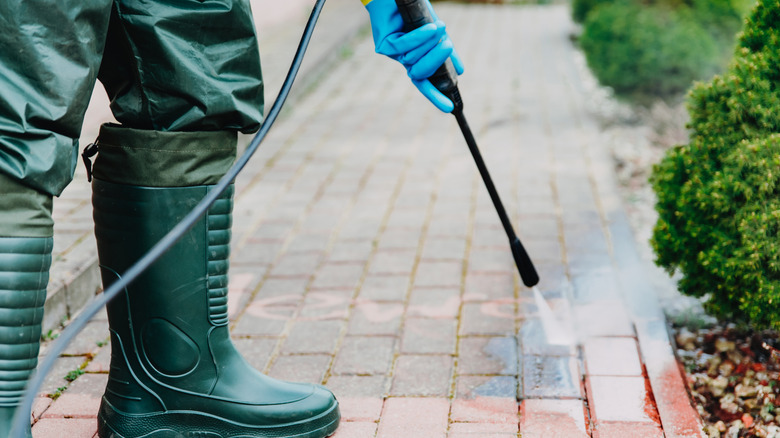
First, you'll need a pressure washer. For this task, you'll need between 1,800 and 3,000 PSI, or lower for specialty surfaces like stamped or sealed concrete. You can find several consumer models that do this; no need to go with professional equipment. When browsing online or at your local home hardware store, look for the number written before "PSI max." These tend to retail for between $100 and $200. If your driveway is shady and damp, you might need to pressure wash it once or twice a year. In that case, the equipment could be a worthy investment. If this is a very rare task, you'll be better off asking friends and family to borrow their pressure washer or renting one.
It's best to go with a turbo nozzle, which rotates to cover more surface area without losing efficiency and power. The rotating motion helps avoid damage, since the pressure isn't applied only in one place. You'll also need some rain boots and a mask, since this is a messy job. It's also best to move furniture off the area and protect windows with blankets, all of which would otherwise get splashed with dirty water.
When you're ready, hold the nozzle at a 45-degree angle, which helps prevent damage. Slowly make your way down the area you're cleaning, moving the power washer side-to-side. As you do, you'll splash dirty water forward, so it's best to work in a horizontal line from side to side, pushing the mess forward in front of you. Then, you'll move forward and repeat the process, "pushing" the residue from earlier forward.