

Don't Mistake It For A Brown Recluse: How To Identify A Hobo Spider In Your Home Or Yard
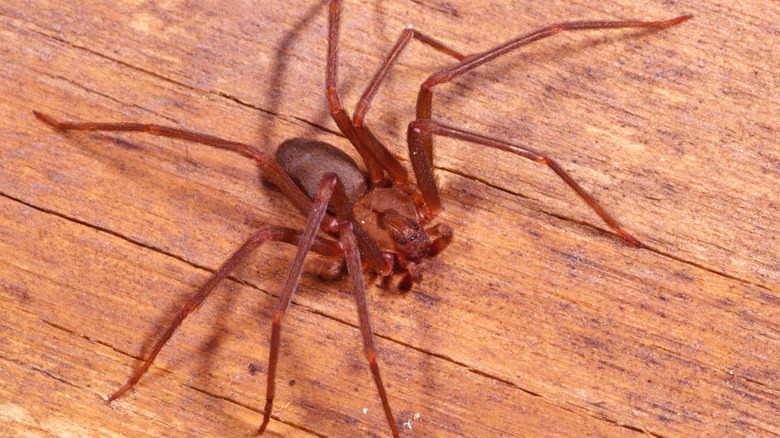
With August approaching, the spider season is officially upon us. While they may already be present outside, spiders looking to reproduce will start venturing indoors by late summer and into fall to find potential mates. Naturally, their presence in our rooms invokes fright, and if they're hued brown, even more so. After all, there's a risk that the uninvited guest in question may be a brown recluse — a venomous spider whose bites may sometimes turn necrotic. But more often than not, the creepy crawly in your house may be a benign hobo, one of the many spiders that gets mistaken for the big bad brown recluse. While they may appear similar, hobo spiders have eight eyes, as opposed to six on a brown recluse, and have a diffused pattern on their backs, rather than the fiddle or violin shape that recluses are prominently known for. Besides, they dominate different geographical ranges within the U.S., and contrary to the notion, are relatively harmless.
Since hobo spiders are highly variable across ages and sexes, identifying them correctly is challenging. Besides, as members of the funnel spider family, they share characteristics with several other species, like grass or domestic house spiders, adding to the confusion. At the very least, you'll require a hand lens to scope out their eye setting, coloration, and patterns, though professionals strive to examine their reproductive structure for a positive identification. In fact, the common refrain is that it's easier to rule out a hobo spider than it is to identify one.
Basic features to help you distinguish between a hobo and a brown recluse spider
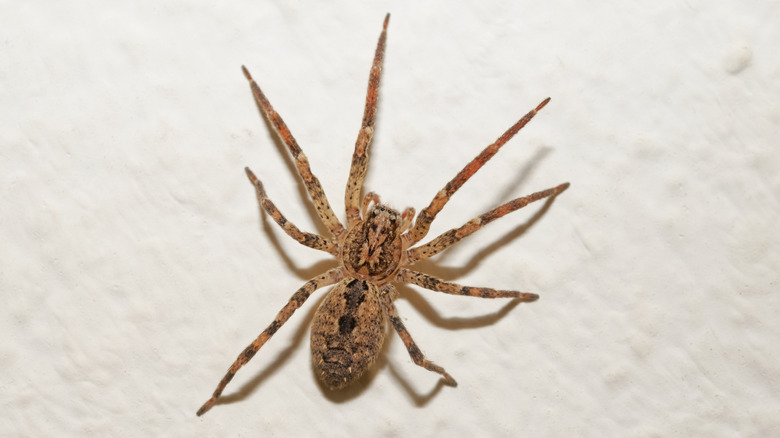
Before touching upon physical specifications, it's important to note that hobo spiders are found mainly in the Pacific Northwest, with their southern range terminating in Utah. Brown recluse spiders, on the other hand, are more common in the South, Midwest, and increasingly Mid-Atlantic states. So, outside of these areas, you're probably dealing with other common spiders you may see in your home. Coming to physical characteristics, hobo spiders have eight eyes, split across two rows. However, the eyes farthest on each side of the top row sit closer to the bottom row, appearing as if placed diagonally. In contrast, brown recluse spiders have three pairs of two eyes each that trace a semicircle on their face.
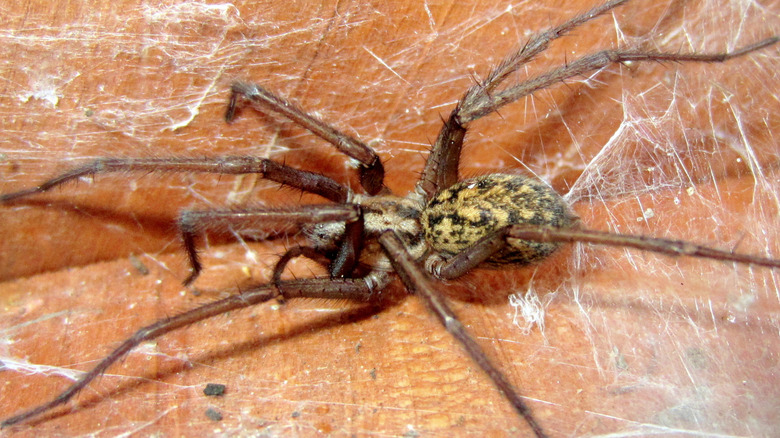
If you examine a hobo's cephalothorax, a.k.a. the main body part from which its legs emerge, you'll see that it's mostly brown with a few darker markings interspersing the area. However, these do not form any identifiable pattern, unlike a brown recluse that has a marked fiddle-like form in this region with the tapered part facing the abdomen (the body section immediately following and attached to the cephalothorax). In the case of the hobo, its grayish abdomen usually features light, yellow-toned, triangular markings (shaped like a chevron pattern), though you'll need a hand lens to make them out. Other than that, the legs of hobo spiders are a matte, uniform color, without any rings or banding, though with lots of fine hair. They usually appear stockier than recluses that have more delicate-looking legs.
Identifying a hobo spider by their body size and habitat
Hobo spiders, like brown recluses, are considered mid-sized, with primary bodies measuring between ⅜ and ⅝ inches and extending an extra 2 inches after including their legs. Brown recluse spiders, in contrast, are about a quarter or half inch long and gain an additional length equivalent to a 50-cent piece when their legs are extended. Although the size difference isn't very evident upon the initial meeting, if you happen to have a ruler on your side, that's another touchpoint to consider.
Another way you can avoid mistaking a hobo spider for a brown recluse is by their habitat, provided you find one inside your home or out in your yard. A hobo spider spins a flat, white sheet that usually leads back into some hidden object, like bricks, firewood, or rocks, or a deep crack or crevice, like in the foundation. When an insect passes by the web, the movement notifies the spider, which comes out to consume it. Brown recluse spider webs look so different in that they aren't built to trap insects. Instead, they resemble mini retreats. As such, these appear as loose, creamy silken strands massed together haphazardly like a cobweb in disuse — unless it's winter, when they would take a cozier, cocoon-like form. Though, curiously, female recluse spiders use them for their egg sacs. These retreats are most common in secluded areas of the home, generally by the wall or up on the ceiling.