

Encourage Tomato Plants To Ripen And Turn Red With A Clever Trick
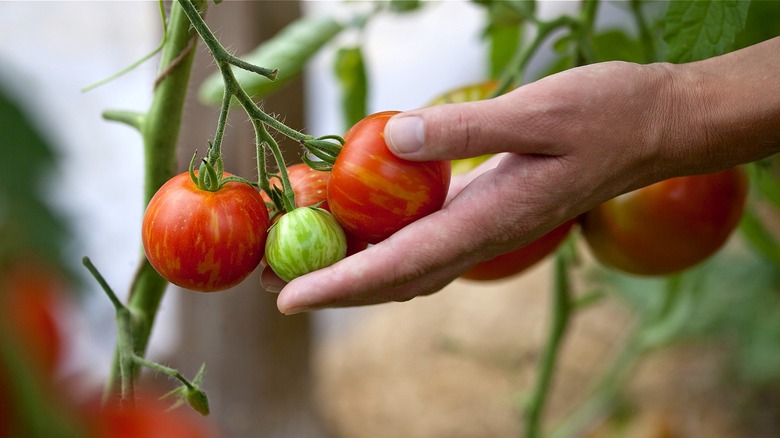
As one of America's favorite garden crops, tomatoes are relatively easy to grow and produce a good yield for their size. This makes tomato plants a popular option for vegetable and fruit gardens across the country. Of course, the hope is to grow tomatoes to their full red potential, and there's actually a simple way you can hasten them along: pruning the suckers from indeterminate tomato plants.
What do we mean by indeterminate? As the name suggests, this type of tomato plant's growing isn't fixed; only the first frost will signal that its season has come to an end. Determinate tomato plants, on the other hand, do have an end point, growing only up until their determined size. This pruning trick, as a result, doesn't apply to determinate tomato plants. A few indeterminate tomato varieties include 'Brandywine,' 'Sungold,' and 'Cherokee Purple' (a slicing tomato).
Because indeterminate tomato plants continue to grow, pruning away the suckers helps out with energy conservation. How so? At an early stage, tomato plant suckers are simply leaves, but as they grow, they will use more energy. By removing them, you allow that energy to go elsewhere, like to the main branches growing the tomatoes. The result? Faster ripening fruit, which for tomatoes, means the tomatoes will turn red. You can think of this gardening hack as one of the best ways to ripen the green tomatoes in your garden (so long as they're an indeterminate variety).
How to prune a tomato plant to speed up ripening
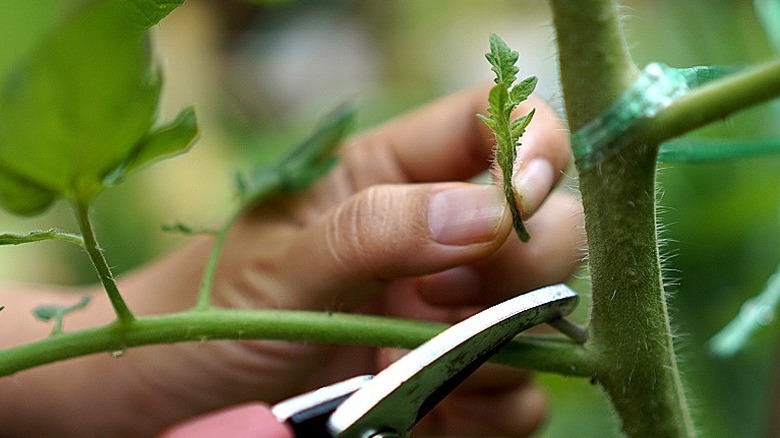
To prune indeterminate tomato plants to help them ripen faster, you'll want to start at the lowest section of the plant, and then look along the main stem. With this trick, you'll only be removing the suckers, which you'll find growing between a branch/leaf and the plant's stem (see above image); this is also called the "axil," so you'll want to look at each axil to see if there's a sucker growing. As the University of Wisconsin-Madison Extension explains, you want to remove all suckers but one.
Leave the sucker growing below the first branch with fruit. This is why you want to start from the bottom of the plant, as you don't want to miss that specific sucker. Again, by removing the suckers, this will allow more energy to go to the branches growing fruit, helping those branches to ripen at a faster rate. A timeframe for this pruning hack is June until a few weeks before you plan to pick your tomatoes.
Also, while this ripening hack is specific to indeterminate tomatoes, pruning the lowest leaves of a tomato plant is a best practice for determinate and indeterminate varieties alike. The benefit of removing the bottommost leaves as the plant grows is that this improves the airflow around the plant, an important factor in keeping it disease-free. With poor air circulation, there's a greater risk for mold to develop.
Further, this maintenance creates a clearance between the tomato plant's leaves and any splashes from the ground, where diseases begin. (See our list of homegrown tomatoes, ranked from hardest to easiest to grow.)