

What Color Porch Light Attracts The Most Bugs?

If you light it, they will come. "They" being bugs. Many bugs gather around light, so lighting up your porch at night can result in a profusion of insects flitting about just outside your door. The degree to which bugs find themselves flying around a light is all about wavelength, and what the insects can actually see.
Insect vision perceives short-wavelength colors, like green, blue, violet, and ultraviolet, better than it sees long-wavelength colors like amber, yellow, orange, and red. The cool white bulbs found in many porch lights fall into the short-wavelength category as they contain blue wavelengths. So of commonly used bulb colors, cool white bulbs draw in the most insects and are the ones to avoid if you want to reduce bug action around your porch light.
Before we get into details, let's clarify the idea of an insect's "attraction" to light. Prior to 2024, scientists widely assumed insects navigated toward artificial lights by confusing them with the moon or stars. However, a 2024 Nature Communications study revealed bugs aren't actually attracted to light — they're disoriented by it.
Insects rely on natural skylight to identify "up" via the dorsal light response, keeping their backs tilted toward the brightest source. When they end up near artificial light, this instinct traps them in continuous turns around the bulb. Consequently, the number of bugs around a specific porch light depends on how visibly bright that light color appears to them mid-flight, not an inherent color preference.
Avoid cool white bulbs for fewer bugs
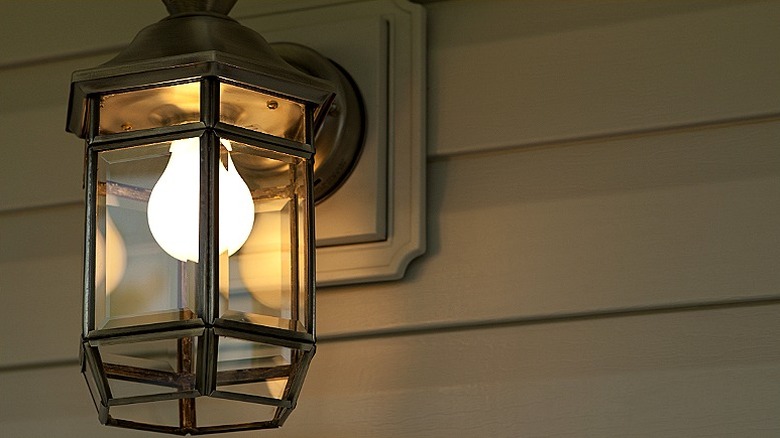
The new science refuting the idea of attraction doesn't change the fact that you'll see the most bugs around a cool white light. But that doesn't mean you have to give up on white light bulbs altogether if you want to reduce the number of insects visiting your porch.
While cool white bulbs, including those designated as "daylight" bulbs, promote insect gatherings, there are also warm white or neutral white light bulbs. Neither of these work as well at keeping bugs away as an amber or yellow bulb (including yellow bulbs marketed as "bug lights"), but you should see fewer insects than if you were using cool white bulbs.
As mentioned, orange and red are among the light colors insects can least perceive, but these are not popular light bulb choices for human visibility, aesthetic, and cultural reasons. On the flip side, short-wavelength ultraviolet is so visible to insects that it's used in bug zappers.
Other factors combine with bulb color to affect insect light sensitivity. In a paper presented at the 2016 annual meeting of the American Association for the Advancement of Science, scientists found that LED bulbs with warm color wavelengths drew the fewest insects, while incandescent bulbs pulled in the most bugs. Insect eyes excel at recognizing movement and can see flickering light.