

Every Victorian House Had One — Now It's A Glittery Thrift Store Gem For Collage Walls
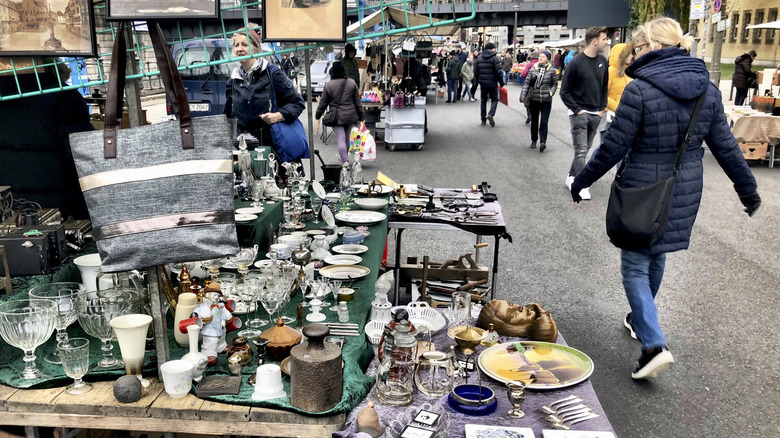
In the late 1800's, many Victorian homes had a small silver tray in the front hall, typically used for "calling cards." Guests left their engraved paper visiting cards on this tray to show they had called, even if the homeowner was not home. This was an important social ritual for the Gilded Age. Once electroplating was patented in England in 1840, it made silver objects within reach of anyone with a middle-class income.
Within a generation, nearly every house had card trays, bread trays, and even dresser trays, which is why you can still find them at antique malls and estate sales. You may not have anything to serve on a tray, but once you hang these silver trays on a wall, they do something a print can't, because silver bounces light throughout the room. A monogram of the previous owner only adds to the mystique and history of the tray.
A tray hung near a lamp or opposite a window throws a soft glow back into the room. Posters, photographs, and collected postcards can spruce up a collage wall, but they are all the same basic rectangular shape, and are mostly matte and all roughly rectangular. But two or three trays scattered through the arrangement add depth. Victorian trays came in oval, scalloped, and rectangular shapes, often with cast handles. Their prices secondhand vary based on their designs, age, and condition, ranging from $50 to over $600 on eBay, but you could luck out and find one cheaper at the flea market store.
What to look for Victorian trays for a collage wall
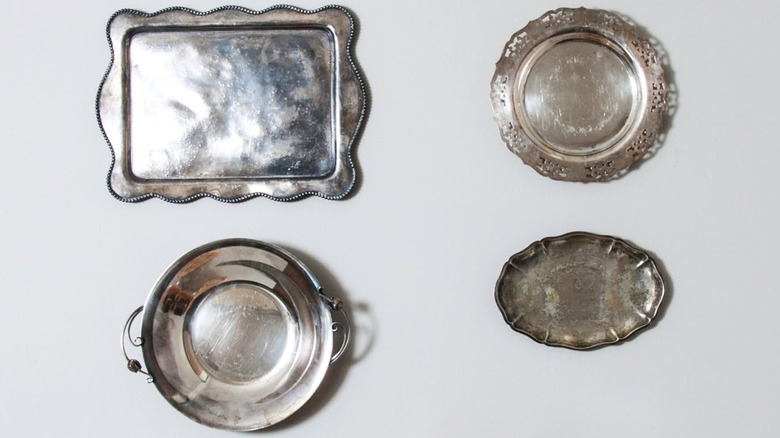
Flip over antique trays before you buy. "EPNS" means the object is made from electroplated nickel silver, and "quadruple plate" is even heavier electroplating. Both are what you want for wall decor, because they're inexpensive and the plating wears well. Sterling will be stamped sterling or .925 and costs considerably more, which is lovely but wasted on something hanging on the wall. American makers worth recognizing include Meriden Britannia, Reed & Barton, Pairpoint, and Derby. English pieces from Elkington or Mappin & Webb also turn up.
If you find trays suitable for your collage wall, avoid polishing it too much. A tray polished bright as a mirror looks too much like a serving piece and will show every fingerprint. Leaving a little tarnish in the recesses of the pattern makes the design easier to appreciate from a distance. Try cleaning the flat areas and leave the crevices alone. If you have a truly grimy piece, the best way to clean it is without using any chemicals. Trays with plain centers also take waterslide appliqué transfers or hand-painted lettering well.
Since trays weigh more than plates, opt for spring-wire hangers that are rated for the weight. Footed card trays will sit awkwardly flat against a wall, so lean those on a picture ledge rather than fighting them into place. And if you come home with more than one wall can hold, there are plenty of stylish ways to give vintage silverware a second life.