

The Common Scissor-Sharpening Hack That Simply Doesn't Work
We may receive a commission on purchases made from links.
Whether you're crafting, dressmaking, trimming cut flowers from the garden, or performing some other task, it can be pretty frustrating to discover that your scissors are blunt. Among numerous suggestions for fixing the problem is a popular hack that says you can sharpen scissors by running a screwdriver shank along the blades. Unfortunately, although you might see any number of videos and websites recommending it, it simply doesn't work.
There are a number of similar hacks around. Using a glass bottle, for example. However, while there are some ways to sharpen scissors like magic that are effective, that's not true of the ones that suggest rubbing glass or metal items against the blades. To be fair, they may appear to be sharper briefly, and it may help in a pinch, but they'll soon be dull again.
What rubbing the blades with a hard object does is called honing. It's what you see chefs do when they run kitchen knives along a steel. When scissors cut any material, the very edge of the blade gets pushed out of shape a little. It's not enough to see with the naked eye, but it does impact cutting ability. Honing flattens out these tiny imperfections, realigning the blade. So for a while they cut better again. It's only a short-term fix, though. Sooner or later, the hack stops making a difference, no matter how hard or often you rub.
The difference between honing and sharpening scissors properly
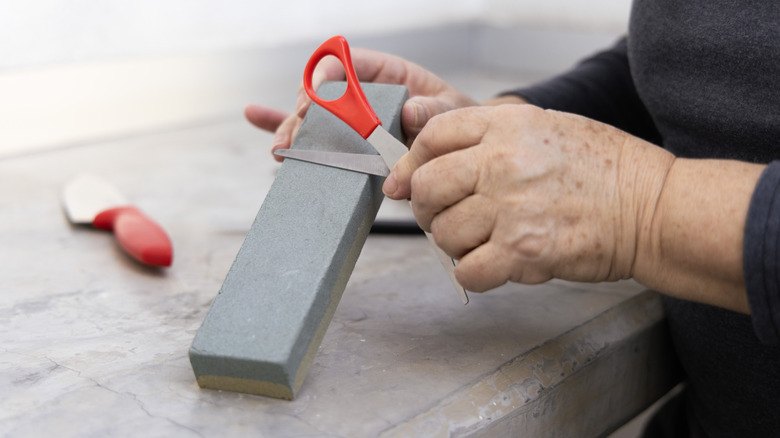
Honing is intended to return a blade to its original profile, but sharpening scissors properly means developing a fresh cutting surface by removing the old, worn-out edge. To do that, you need some kind of abrasive to grind a little of the metal away. Both a screwdriver shank and a glass bottle are smooth. It's a bit like trying to use tissue paper instead of sandpaper.
Arguably the best tool for the job, and the one used for ultra-sharp kitchen knives, is a whetstone. They have been around for generations. However, it's vital to maintain the correct angle on the cutting edge, and there's definitely a learning curve with this kind of sharpener, as there is with modern diamond stone equivalents.
Some say it's worth the effort; others might prefer an alternative that's easier to use. Pull-through sharpeners have pre-set grooves for the ideal edge angle. You literally pull the scissors through the slot a few times, and that's it. The Accusharp Shear Sharp is a popular example available on Amazon and comes with a separate knife sharpener for around twenty bucks. It's not something you'll find in a chef's kitchen because they can be too aggressive for high-quality professional kitchen knives, but to sharpen household scissors, they're absolutely fine.