

Every House Had One In Japan For Centuries — Now It's Valuable Table Decor To Hunt For

In our hectic world, the quiet ritual of enjoying a cup of tea helps us relax and focus. Watching your favorite tea steep and taking in the brew's aroma are part of the experience, but what about the act of boiling water? Enter the tetsubin. This cast iron kettle has been part of Japanese culture for more than 400 years, playing an important role as both a practical kitchen implement and an elegant component of Japanese tea ceremonies.
The name "tetsubin" combines the Japanese words for "iron" (tetsu) and "pot" (bin). Their solid iron composition improves the taste of tea by adding trace amounts of iron to the water, giving tea a richer and less bitter flavor. Along with their ability to impart better flavor to tea, tetsubin often have decorative exteriors that add historic charm to wherever you choose to display them, often featuring nature motifs or geometric patterns. One of the most famous is types is the hobnail or "hailstone" pattern, called "arare," which is accomplished by hand-pressing individual dots into the kettle's sand or clay mold.
The tetsubin's evolution from practical object to decorative treasure has elevated it to one of the most iconic representations of Japanese culture and craftsmanship. While low-quality cast iron products are easy to find online, tea aficionados should keep an eye out at the thrift store for genuine Japanese tetsubin to elevate their tea ritual.
What is a tetsubin?
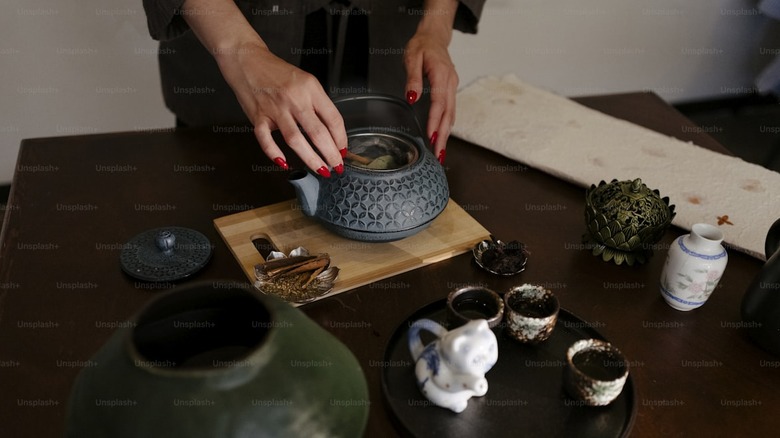
First created in the 1750s during the Edo period, tetsubin exploded in popularity around 1800 as green tea became more widely available to ordinary Japanese citizens. Though domestic demand dropped during the Meiji era (1868-1912) thanks to industrialization providing cheaper, mass-produced kettles, international demand for Japanese arts and crafts continued to grow after the 1853 trade agreements that opened up Japan to the West. Japanese ironware such as tetsubin captured international interest, even being displayed at world expositions in the 1860s and '70s.
Today, tea enthusiasts treasure tetsubin not just for their craftsmanship, but for their impact on how tea tastes. The additional iron leeched into the water during boiling makes hard water in particular taste sweeter and smoother. Over time, the tetsubin's interior builds up a mineral layer known as "yuaka" that protects the kettle and contributes to tea's flavor. True vintage or antique tetsubin will have a visible mineral layer built up from years of everyday use.
There's a second important characteristic to look for inside the kettle. If you find one that has a glossy enameled interior, that's actually a tetsukyusu ("iron teapot"), a much more widely available product popularized in the 1990s for Western markets. It serves a different purpose: the tetsukyusu is for brewing and serving tea, while the tetsubin is for boiling water. The tetsukyusu's enamel lining prevents the beneficial traces of iron from entering your tea. Worse, trying to boil water in a tetsukyusu on a stovetop can actually crack the enamel. Check your potential purchase carefully because tetsubin and tetsukyusu are frequently mixed up, with the label "tetsubin" applied interchangeably to both.
What to look for in authentic Japanese tetsubin
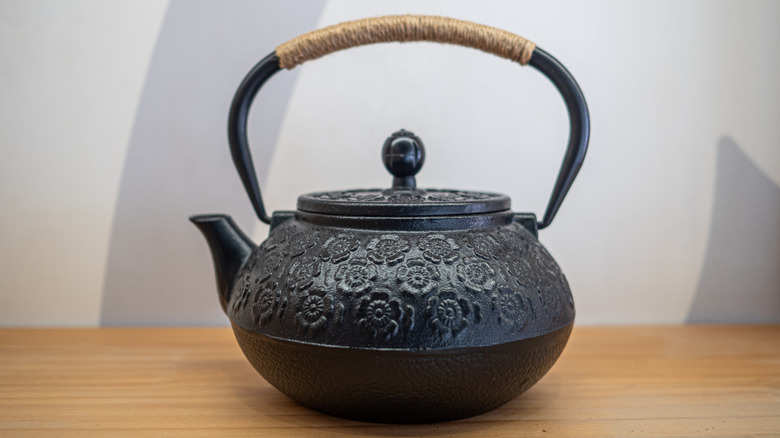
The ease of finding a tetsubin to use or display depends on how authentic you want yours to be. Thrift stores and online marketplaces alike abound with cheap imitators of this time-tested Japanese art, so it's important to shop carefully. Lower-priced kettles are often mass-produced from lower-quality cast iron, which has a rougher texture that affects both the outer appearance and the quality of the pour. The lid may not fit cleanly, and the iron could even crack from temperature stress.
When someone buys a tetsubin, they're investing in a one-time purchase that's not only practical, it's a display-worthy heirloom. Hand-cast ironware from the Nanbu region was designated a Japanese Traditional Craft in 1975, and the region's heirloom-quality tetsubin can be identified by an official Nanbu Tekki designation mark. A genuine tetsubin's price will reflect the time and skill that went into its production. An antique tetsubin, especially one signed by the artist who made it, can command more than $500, sometimes even thousands of dollars on auctions sites. Tetsubin made in the more modern era will typically be cheaper, though prices range widely from around $60 to over $600 depending on how, where, and when the kettle was produced.