

What Does First Blush Mean For Ripening Tomatoes?
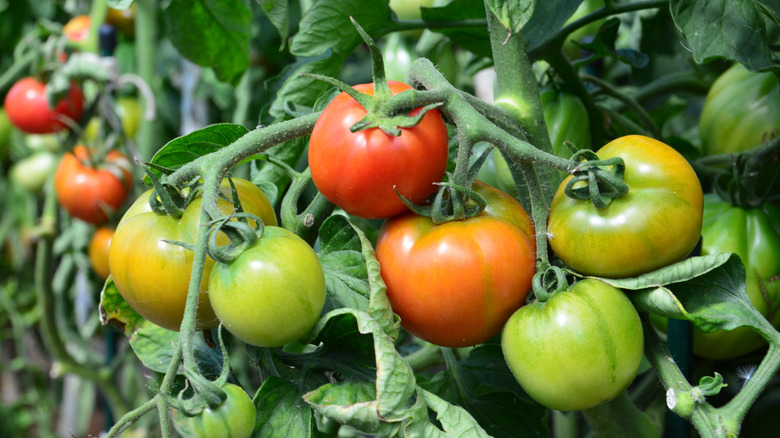
Do you find yourself boosting the soil with extra fertilizer or stripping off foliage to encourage tomatoes to ripen faster on the vine before a frost? Or, conversely, do you find yourself pulling out all the stops to prevent your tomatoes from maturing too soon and going bad? Either way, it'd be nice to have some control over when your tomatoes ripen so they don't go to waste, and thankfully you can if you pick them at "first blush."
So what does "first blush" mean in the context of tomatoes? Basically, tomatoes ripen in six different stages, and first blush, also known as the "breaker stage," is the second in line. It's the point when green tomatoes begin to blush or develop a different hue, possibly along the spectrum of red, orange, pink, or yellow, depending on the chosen tomato varieties, around their blossom end. In commercial terms, as stipulated by the United States Department of Agriculture (USDA), the blush wouldn't cover more than 10% of the total surface area — anything over that is classified as the turning stage or later in ripening (though those tomatoes also make fine candidates for off-stem ripening).
However, as home gardeners, what's more important to understand is that once a tomato starts blushing, it's considered "vine ripe." In other words, the fruit has reached a point where it can continue ripening after harvest and develop its mature color on the countertop.
When harvesting tomatoes at first blush makes sense
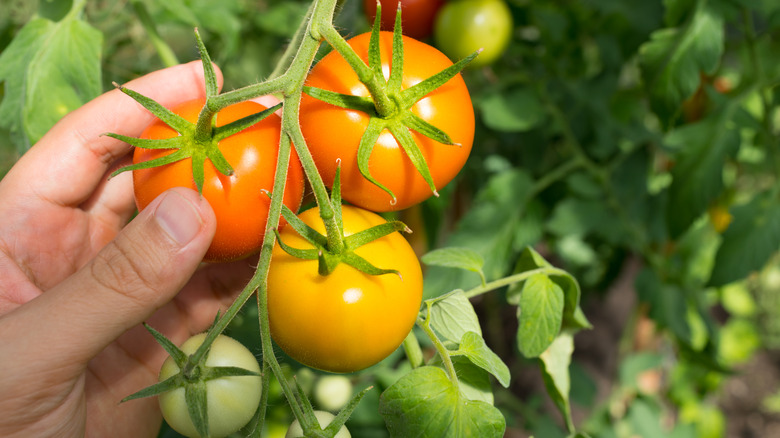
There are clear benefits of harvesting your tomatoes when they're slightly green and blushing. The major one being if you're tired of defending against squirrels, birds, and myriad other common pests that attack your tomatoes in the garden. Clearly, they know better when the fruit is sweet and fully ripe, though some believe the vibrant red color (where it applies) may also have a role. So, harvesting tomatoes early helps you beat them to it.
Besides, the longer the fruit remains on the stem exposed to nature's vagaries, the greater the chance that it may spoil. For instance, if you expect a heavy rain or storm in a couple of days, picking blushing tomatoes helps avoid the risk of them cracking or splitting open from having absorbed excessive moisture. You can similarly avoid chilling or frost injury by harvesting blushing tomatoes before temperatures drop too far.
Likewise, if you're expecting a heat wave or live in a climate where summers can get extremely hot, early pickings can prevent sunscald. Tomato plants temporarily stall once temperatures exceed 95 degrees Fahrenheit. At high temperatures, the fruits may struggle to develop their characteristic hue because production of pigments such as lycopene can be inhibited. So, harvesting now allows you to ripen them indoors on your own schedule. Such a measure also lightens the fruit stems and takes some of the pressure off the stakes.
The battle of tastes and how it influences fruit maturity
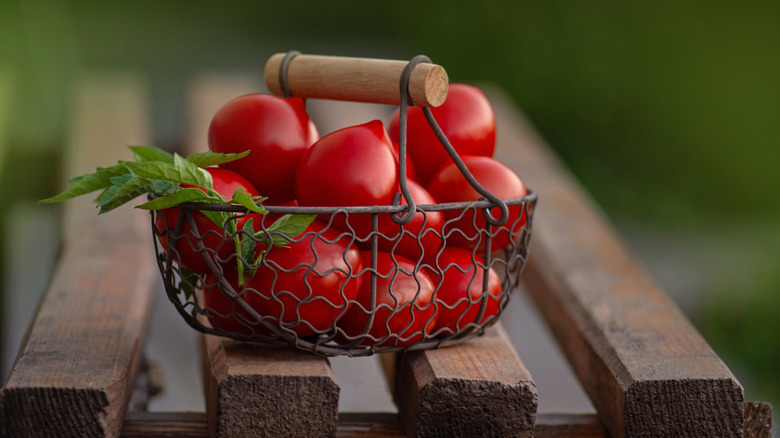
For all the benefits, we must also acknowledge that there may be a slight trade-off in terms of flavor and texture. Although hotly debated and widely studied, it's commonly believed that tomatoes allowed to mature on the vine taste better or sweeter than those harvested at first blush and ripened later. Based on some studies published in 2000 and 2010, stem-ripened tomatoes may have a higher ascorbic acid content and soluble solids compared to blushed tomatoes. They also tend to have a firmer skin, though the overall differences can be slight and difficult to notice.
When put to the test in a study comparing on- and off-vine-ripened hydroponic tomatoes, a 100-person panel didn't notice any significant sensory differences in taste despite differences in chemical composition. Even anecdotally, most home growers can't seem to differentiate the two, unless they've a highly sensitive palate or are growing certain varieties more sensitive to their environmental conditions. The easiest way to put this debate to rest is to test it yourself. Leave a few to ripen on the stem (if birds spare them) and remove others at first blush. To ripen breaker-stage tomatoes, you can leave them on the counter or in another area where temperatures remain between 65 and 85 degrees Fahrenheit. If you need them sooner, you can place them in a paper bag, where the ethylene they produce can help accelerate ripening.