

Skip Lenox: The Valuable Porcelain China Brand That Collectors Dream Of Finding
We may receive a commission on purchases made from links.
When thrifting, you tend to see the same brand names over and over, like Noritake and Wedgwood. Lenox in particular gets a lot of attention because collectors have spent decades teaching thrifters that certain Lenox patterns are worth a second look. But there are plenty of other valuable vintage china patterns worth looking out for while thrifting, such as the stunning porcelain brands Coalport and Royal Limoges.
Royal Limoges was founded in 1797 in Limoges, France. Historically, the company owned its own kaolin quarries and mills, giving it rare control over every step in the process, from raw material to finished piece. That helps explain the reputation Limoges porcelain developed for being exceptionally durable and translucent. Today, the Four des Casseaux kiln used by the factory in the 19th century is now a historic monument and museum in Limoges.
Royal Limoges holds its value, whether the pieces are new or old. For new, a single MAK Grey dinner plate sells for $130 at Scully & Scully. Older, discontinued patterns can still command respectable prices, too. A set of two Marie Antoinette plates can go for over $250 on eBay, for example. Replacements currently lists a Nymphea White dinner plate for $55.99. That adds up quickly if you find an entire service at a thrift store.
Antique Limoges can be worth considerably more. Traditional 19th-century Limoges pieces are often valued in the $500 to $5,000 range, depending on the piece and its condition. Specialty pieces, including vases and covered boxes, can go higher.
Finding Royal Limoges
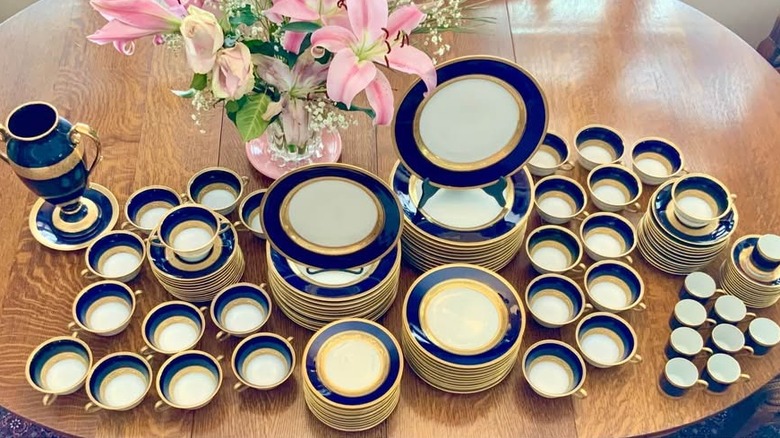
Royal Limoges didn't actually start using the name "Royal Limoges" until 1989. Before that, the factory went through a slew of names and marks, including Porcelaines Alluaud, CFH, GDM, GDA, and SLPG. You may find a plate, see something like "GDA France" stamped on the back, and assume it's obscure old china. In reality, it might just be a piece of vintage Limoges. Those letters are often the key to telling collectors that the piece came from the same historic Limoges factory that eventually became Royal Limoges.
The G.D.A. period is especially fascinating because of its influence on the Art Deco movement. In 1925, at the Paris Exposition of Decorative Arts, the company won the Grand Prize for its "Apollo," now sold as Nymphéa. Despite the French provenance, it's common for these pieces to turn up in America. The factory produced dining car china for the New York Central Lines, so American railroad pieces can occasionally make their way into U.S. thrift stores and antique shops.
As always when thrifting for fine china, be particular about the condition. You want the pieces to retain their color and be free of chips or cracks. Complete sets are generally much more desirable than a pile of mismatched plates. The next time you're standing in front of a thrift store china shelf, don't just look at the pattern on the front. Be sure to read up before you head out thrifting so that you can learn how to tell whether thrift store dishware is valuable.