

Not A Rake Or Torch: The Better Tool To Remove Weeds And Grass From Gravel Driveways
We may receive a commission on purchases made from links.
If you've been using a blowtorch to clear your gravel driveway of weeds, then you may well find yourself asking whether you should really be using this fiery tool around your landscape. Any dry material is at risk of combusting, as is any landscape fabric that's managed to poke its way through the gravel. And it's rarely 100% effective. Similarly, while a regular garden rake comes without the obvious pyrotechnical problems of a gas-powered torch, you may find yourself wondering just how effective your weeding strategy is. Yes, a rake may be good for removing surface clippings. But is it really dredging up the roots of those weeds, and therefore preventing them from coming back? Chances are, it's probably not. The issue with weeds is that, unless you're meticulous, they have a happy habit of coming back over and over again. It's annoying, and can leave you wondering why on earth you spent so much time with your torch or rake, only to have them come back again with a vengeance.
If all of this is ringing true, then don't worry. There is a better solution. And no, we're not talking about ordering a bottle of round-up and conducting chemical warfare on your driveway weeds. Instead, we're talking about a specialized and lesser-known tool called the scuffle hoe. This gardening tool can save your back while pulling weeds out at the roots, and it's especially useful in gravel driveways. The hoe's "head" is kind of shaped like a horse stirrup, however, that metal "loop" is actually a blade. It's designed to undercut your weeds and pull them up, roots and all. These tools are widely available at big-box chains like Home Depot, or you can pick one up on Amazon, like this Scuffle Garden Hoe from DonSail.
How to clear weeds and grass from your driveway with a scuffle hoe
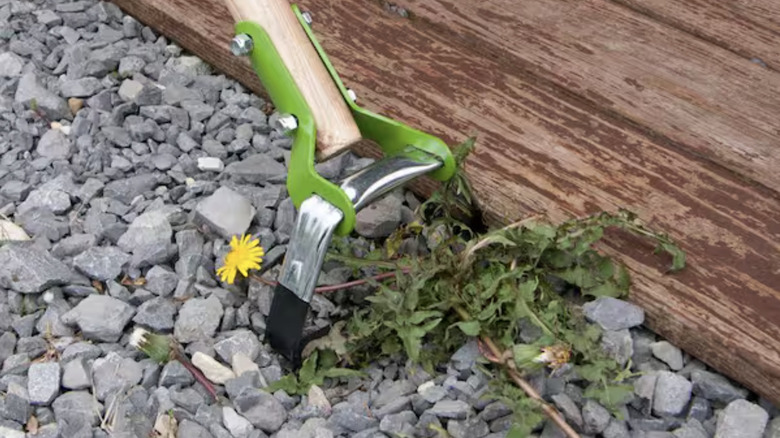
The basic action required to use a scuffle hoe is straightforward. You apply some downward pressure, agitating the hoe forward until it begins to "undercut" the weeds beneath the gravel. Scrape it back and forth, and work your way along your driveway in lines — being meticulous to ensure you don't accidentally miss a strip. It can pay to work from the edges first and then work your way inwards. As for when to do it, it's usually best to tackle weed growth early, especially with a scuffle hoe. Dense growth of mature weeds may be difficult to remedy this way, since the roots and stems can become tough to cut through and remove.
Once the weeds and grass are loose, you will then want to think about how you'll gather the cuttings. There are several ways that you can do this. For example, once you've cut out all of the weeds and grass, you could use a leaf blower to clear the loosened material. Alternatively, if your trusty rake now feels somewhat left out of your driveway maintenance routine, you could show it some love by using it to collect the majority of the clippings. Whichever method you choose, aim to be as meticulous as you can. Leaving weed cuttings in place is one of the most common weeding mistakes, especially if any of the plants were allowed to develop seed heads before you cut them. If these are left in situ, they could easily germinate again, thus proliferating your problem instead of solving it.