

The Bird Bath Design From 1925 You Can Recreate With Surprising Ease Today
We constantly hear how history repeats itself and how the more things change, the more they stay the same. Yet, it's still surprising to discover a DIY bird bath design from 1925 that's so similar to DIY bird baths we've reported on more than 100 years later. This easy-to-build design, from the August 1925 issue of Better Homes & Gardens magazine, uses an old garbage can lid as a water basin for birds.
By the 1920s, home gardens had been growing in popularity among ordinary Americans for some 30 years. Activities from child's play to social gatherings took place in gardens, and bird-watching took hold as a popular hobby. Gardens were created to accommodate birds with feeders and bird baths.
It was against that backdrop that Better Homes & Gardens provided its bird bath design, which was submitted by a reader, A.F. Rosencrans from Des Moines, Iowa. Rosencrans wrote about the simplicity of the DIY, "... This bath can be made by anyone at a very small expense for this one cost only sixty cents plus an old garbage can lid."
Recreating this 1920s DIY bird bath today will likely cost more than 60 cents, but it should still be inexpensive, especially if you follow Rosencrans' lead and look for bargains. The pedestal Rosencrans used was a staircase's newel post, which was sourced from "a second-hand lumber dealer for fifty cents." In today's dollars, this homemade bird bath's total cost of 60 cents would be about $11.32.
Recreating this 1925 garbage-can-lid bird bath DIY
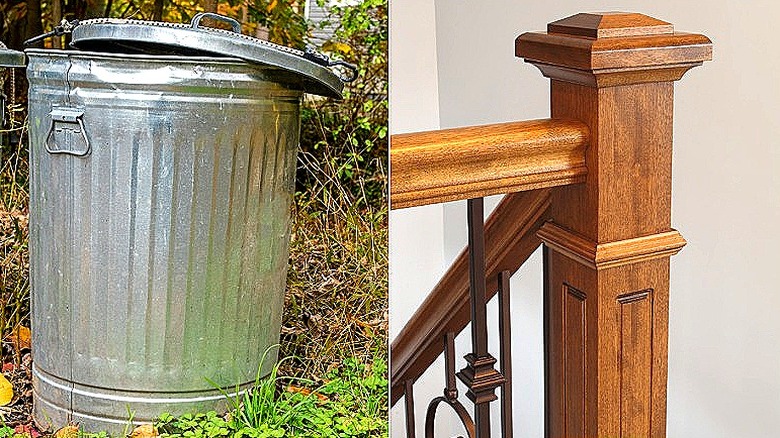
Newel posts, like the one A.F. Rosencrans used in 1925, are, of course, made from wood, which may not be the best material for a bird bath. With splashing from the basin, rain runoff, and condensation constantly re-wetting the post, it will eventually rot. That said, if you're set on recreating the 1925 BHG bird bath design exactly, just be sure to waterproof your wooden post with an outdoor sealer.
A scan of social media, meanwhile, shows a number of informal, inexpensive supports for garbage-can-lid bird baths, including 5-gallon buckets, tree stumps, small stools, cinder blocks, a pile of rocks, and milk cans. Another take on the old trash can lid-turned-bird bath is to use the ground as support, thus creating a free option if you already have the garbage can lid. (See more bird bath designs that add instant delight to any yard.)
You're probably wondering what the last 10 cents of this 60-cent project was for. It was for cornice moulding, used to trim the base of the bird bath, and to beautify it. Rosencrans doesn't say what the bird bath's base was made out of, but notes that it was 14 inches square and 2 inches thick.
As for the assembly, it's very similar to DIYs today: The bird bath's pedestal is attached to the base, and the garbage can lid is affixed to the pedestal. Rosencrans noted that the final bird bath stood 32 inches tall, but that each final project would be unique to the DIYer. Wrote Rosencrans, "The height over all is thirty-two inches; this, however, should be proportioned according to the size of the lid."