

What That Yellow Label On Appliances Actually Means

We may receive a commission on purchases made from links.
Sometimes it's necessary to update an old appliance for better energy efficiency and performance. When you've been appliance shopping, you've undoubtedly seen yellow stickers on washing machines, dishwashers, refrigerators, and other appliances. You've probably glanced at it once and moved on. That yellow label is actually called the EnergyGuide label, and it provides extremely useful information when deciding which appliance to buy, rather than just more manufacturer fine print. The Appliance Labeling Rule came into force in November 1979 and since then, this bright yellow EnergyGuide label has been mandatory on all major home appliances. This legal requirement was introduced to make sure shoppers could compare energy use across competing models before purchasing, instead of finding out that the appliance they bought was a major energy drain and was sending their utility bills soaring.
Appliances such as refrigerators, freezers, dishwashers, and washing machines, as well as appliances built to heat and cool your home like furnaces and boilers or portable air conditioners and plug-in ceiling fans, all have to carry these labels. Pool heaters, water heaters, and televisions also carry them, but interestingly, ranges, ovens, and clothes dryers don't, which seems odd given that they also fall into the common home appliances category — or so you'd think. If you're shopping for an appliance that does carry the federally mandated label, make sure you pay close attention to it and understand what it's showing you.
What information is on the EnergyGuide label?

The EnergyGuide label tells you more than just how much energy an appliance uses. It shows you the manufacturer, the model number, and the approximate size. This information is useful when you are comparing multiple models in the same category. In the middle of the label, you will see a big number — this is how much it would cost to run that specific machine for one year, based on the national average electricity price. There is also a scale with an indicator arrow that shows you where this model falls in terms of energy use when compared to other models with matching features such as size, performance, and output.
Lastly, usually right in the bottom, you'll see the estimated yearly electricity use in kilowatt-hours instead of a price. This is a useful figure if you know how much your electricity costs per kilowatt-hour at home, as what you pay can be wildly different than the national average per unit. If you know your cost per kilowatt-hour, then the estimated yearly kilowatt-hours an appliance uses can quickly tell you how much you can expect to pay for a full year of use with a pretty good degree of accuracy.
How to use the EnergyGuide label when you're shopping for a new appliance
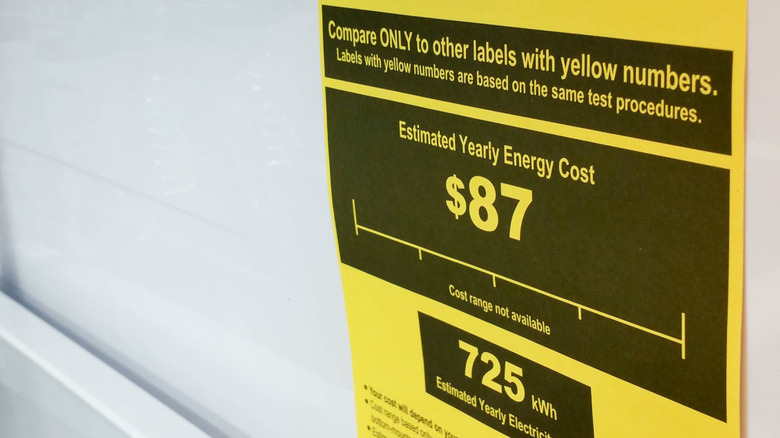
Every home appliance uses a different amount of energy. So, just as the scale on the EnergyGuide label compares appliances of similar size, type, and rating, use the EnergyGuide labels to compare products of similar type, size, and rating when shopping. Otherwise, you're comparing apples to oranges, which renders the label essentially useless. For example, if you're trying to pick a more energy-efficient refrigerator, you shouldn't be comparing a french-door fridge with a tiny under-the-counter refrigerator. The same goes for washing machines and other products.
Additionally, if you want to see whether your old appliance really is inefficient compared to a new one you're considering purchasing, you can use a kilowatt usage monitor, such as this twin-pack of home energy usage meters from Mecheer. These devices plug in between your appliance and the wall and tell you exactly what the appliance is drawing. Then you can compare this figure against the EnergyGuide label of the appliances you are considering as alternatives. And, of course, whichever appliance you buy, there are ways to reduce energy waste while using kitchen appliances to help lower your utility bill.