

Not Thickness: The Curtain Metric To Consider If You Want More Daylight
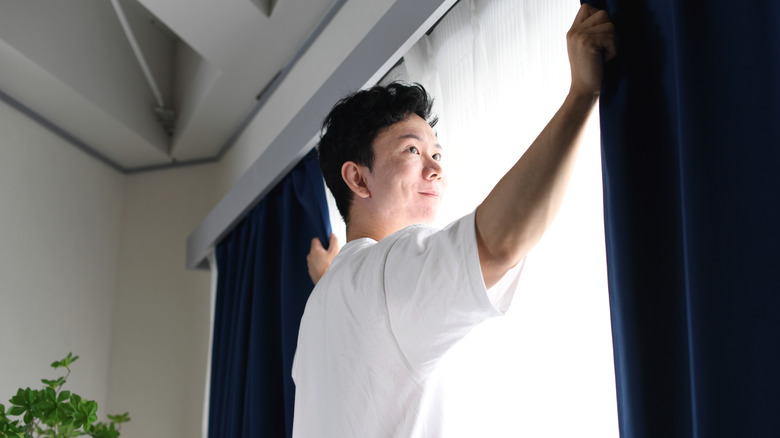
Depending on your decorating style, curtains may feel like an afterthought or the entire focus of your decor. Regardless of whether you love interior design or if you're trying to block out an annoying street light, choosing curtains calls for some consideration. Selecting curtains and rods that look proportional to the room and window doesn't just make the window aesthetically pleasing — it impacts the appearance of the entire room.
One crucial factor that's often overlooked is what interior designers call curtain stack back. Stack back describes the amount of space curtains take up on the sides of the window after they're drawn open. If you want to showcase large, beautiful windows, calculating stack back will help you determine the size of curtain rod you need to ensure your open curtains aren't blocking the view. Similarly, if you're trying to let in as much daylight as possible through small windows, knowing your drapery stack back can help you hang your curtains without obscuring any natural light. The secret to beautiful drapes just requires doing a little math.
The importance of drapery stack back

It's not simply a matter of choosing the perfect curtain rod. Stack back is affected by the number of pleats, fabric thickness, and the hanging hardware, as well as whether the curtains open from the middle or from one side. Designers also consider how much of the view — and of the window itself — you'll want to see with the curtains open.
Plus, stack back has both width and depth to consider. Stack-back width is a metric that refers to how much space the curtains take up when open. This measurement will determine the length of the curtain rod you will need to ensure your open curtains let in that coveted natural light. Stack-back depth is the size of the folds or pleats you create when you open the curtains. Sheer curtains with lots of little pleats will have smaller stack-back depth compared to grommet-top curtains made from heavier fabric.
As you're deciding on the perfect curtains for your space, stack-back width is more important to consider since it will determine curtain panel size, rod length, or both. Once you've calculated your drapery stack-back width, add that number to your window's width to determine what size curtain rod you need.
How to calculate curtain stack back

Designers follow different formulas when calculating drapery stack back, but a few easy ratios will help when planning your window treatment. For example, grommet-top drapes will result in as much as 15% stack-back width per panel, while pinch-pleat, rod pocket, and tab-top curtains all have around 20% stack-back width per panel. That means if you're hanging a 100-inch pinch-pleat curtain panel, it will take up 20 inches of wall space when open, while the same curtain with grommets will have a stack-back width of 15 inches.
If you're limited to specific curtain rod dimensions, Threadwell offers a different formula to help you work out stack back based on rod width rather than curtain width. For a pair of center-opening curtains, divide the rod width by 5 to determine the stack width on either side of the window. For a side-opening single panel, divide the rod width by 2.5. If your curtains are made from heavier or thicker fabric, add a couple of inches to be on the safe side.