

Washing Machines Of The Past Would Look Unrecognizable To Shoppers Today

A trip through the appliances aisle in your favorite secondhand store produces some pretty amazing finds. For example, it's the place to nab the antique washing machine you've been wanting for that old-school laundry room in your farmhouse (and potentially for only a couple hundred bucks to boot). But be warned: Vintage and antique washing machines don't resemble the modern-day agitators that shake your house on laundry day. Instead, a good number of them look a little like a witch's cauldron with a hand-crank pasta maker attached to the top for good measure.
The cauldron-and-crank design of the old wringer washers served very practical purposes, despite the wonky appearance. In the pre-modern eras, laundry chores could be multi-day affairs. This was particularly true if everything, from scrubbing and rinsing to drying, was done by hand.
In these cases, laundry fresh out of the wash tub was soaking wet and needed to be wrung out to rid the fabric of any excess water. This step took laundry from water logged to merely damp, but it was hard on the hands and arms. The addition of a hand crank to the laundry setup not only saved users labor, it also saved time, according to an 1878 ad for a Thomas Bradford & Co machine (via Unbound, a magazine by the Smithsonian). Per the ad, "a boy or girl of twelve years old can wash twelve shirts, necks and wristbands included, in from twelve to fifteen minutes, or two blankets in six minutes."
An alternative to the washing machine's spin cycle
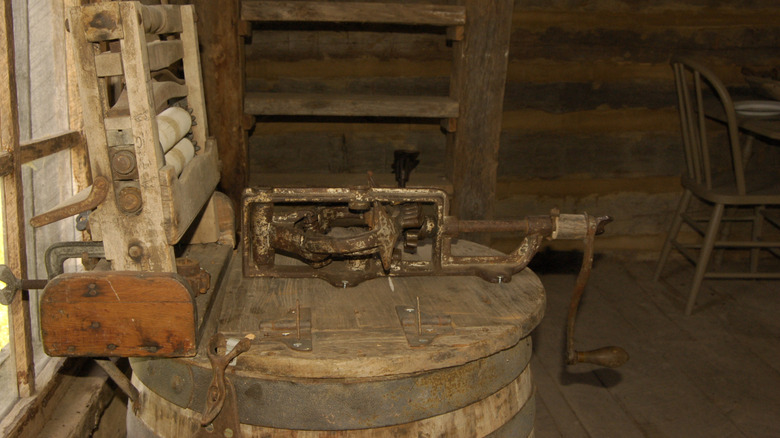
An African American woman named Ellen Eglin invented the first of the wringer washing machine in 1888. The invention featured a hand crank fastened to a common wooden wash tub. The wringer feature served the same purpose that the modern washer's spin cycle does today.
However, it didn't rely on centrifugal force to push the excess water out of wet items as most modern machines do. Instead, the laundry was inserted between two rollers that had a crank attached on one side. This setup squeezed the extra water out of the linens, towels, and clothing once the crank was turned, no hand-wringing necessary. Some hand-crank machines did actually look a bit like a hand-crank pasta maker, though it was damp jeans that emerged out of the backside of the contraption instead of uncooked lasagna noodles. Eventually, hand power was replaced by gas or electricity, though the squeezing action of each design remained pretty much the same.
As for the wash cauldron, which was the early version of the modern washing machine drum, it sat directly below the wringer. The clothes were washed in the tub by hand in the earliest iterations of wringer-style setups and by gas or electric power later on. The tub's position just below the crank allowed any excess water and soap to be captured as each item was wrung out, making a potentially messy setup slightly less so.
The multifaceted evolution of the washing machine
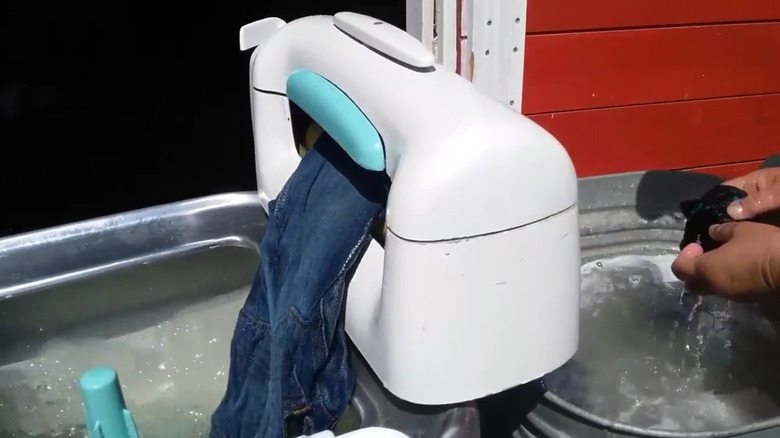
The evolution of the washing machine from rudimentary tool to modern marvel was a long one with many "missing link" machines in between. Like biological evolution, the iterations often split off from the original design before converging once again into the washing machine that you can buy today. Ellen Eglin might have introduced the wringer in the 1800s, but it wasn't the only design on the market. German inventor Jacob Christian Schäffer gave the world one of its first centrifugal-style machines in the 1700s. Both styles of machine were available simultaneously at least somewhere in the world for many years.
Eventually, thanks to advances made during the 19th century, companies like Thomas Bradford & Co, the Hurley Machine Company of Chicago, and the Whirlpool Corporation added their own spin (pun intended) to the washing machine and cranked production of it up a notch (pun also intended). By the time the 20th century was underway, people had their pick of popular brands of washing machines: Their options included both crank and centrifugal styles.
However, unlike today, where you'll find each kind side by side mostly in thrift or antique stores, it was theoretically possible during that era to find both kinds in the same store when you were shopping for a washing machine. In fact, production on wringer-style washers didn't stop until the end of the 20th century, when Maytag finally discontinued its line of them in 1983.