

A Regular Rake Won't Cut It: The Classic Garden Tool Made For Wet Leaves
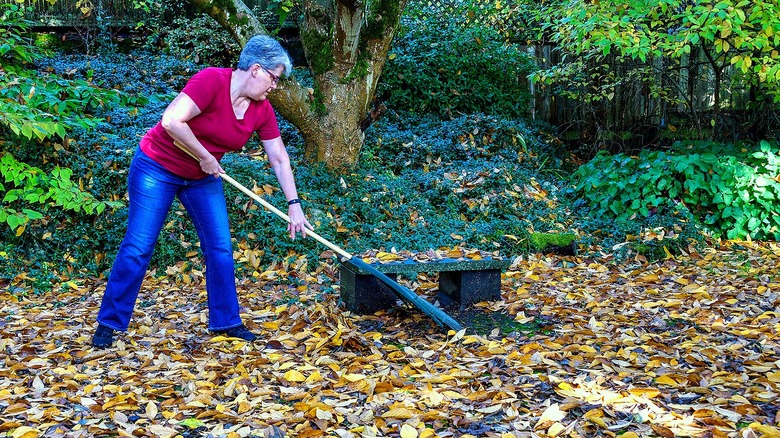
A rake is among the most essential tools to have on hand for any gardener, especially if you have deciduous trees in your yard's vicinity. One will ensure you make light work of those annual fall yard maintenance tasks, like clearing away leaves — both dry and wet. However, even if you own a rake, there are several different types, and each is better for certain jobs than others. For example, if you're often dealing with a lot of wet leaves, the preferred tool would be a specific type of leaf rake: a steel spring rake.
In general, just because a tool is called a "rake," that doesn't mean it's designed to rake absolutely everything. The difference between a bow rake and a leaf rake, for example, is that one is designed specifically for leaves. (We'll bet you can guess which one!) If you have a bow rake, also known as a garden rake, this type of rake, with its short, parallel tines, is built to handle some heavier-duty gardening tasks, like mulch spreading and de-compacting soil. The bow rake's tines would tend to dig into a lawn, which, when you're trying to scrape together a load of leaves, can damage the surface beneath.
To pick up fall leaves, a leaf rake — with its longer, fanned-out tines – is certainly the best tool for the job. However, as mentioned, for wet leaves, it's best if the leaf rake is a steel spring rake, or one equipped with a spring brace. That spring brace is key, as it gives the rake flexibility. This allows the rake to bend under the weight of the wet leaves, rather than snap.
Why a steel spring rake is best for wet leaves
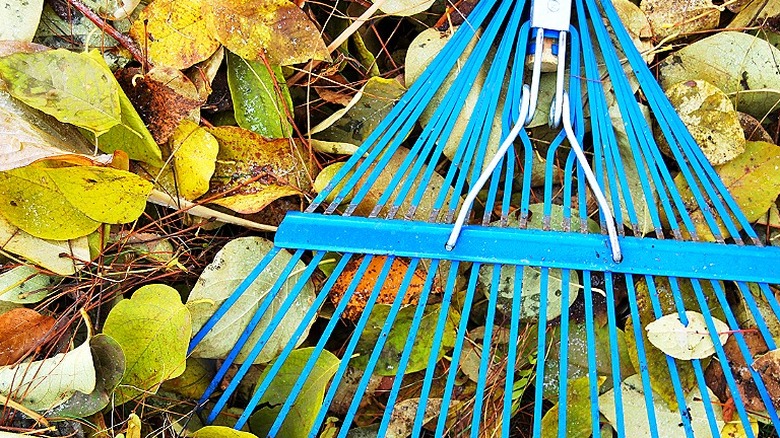
One of the best tips to make raking the leaves in your yard quick and easy is to do so when it's dry outside. This way, you can use a standard poly rake (also know as a plastic leaf rake, which is likely already in your shed). Once yard conditions turn damp, however, that's when a steel spring rake becomes the better garden tool for the task.
Steel spring rakes have robust steel tines, which flex, but rarely give, thanks to the support of the spring brace across the front. Wet leaves are much heavier than dry leaves — they can be up to four or five times heavier — and so you'll need a tool that can work with that weight. Consider: 360 dry leaves equals 1 pound, and a single tree can produce 550 pounds of leaves each year.
So, raking up, for example, 8 pounds of dry leaves in the afternoon, could suddenly turn into a job that requires you to pick up 40 pounds of wet leaves instead. A flexible steel spring rake, designed to "spring" back into shape, would be able to get under that compacted extra weight and move the leaves.
Steel spring rakes are available with 18 tines or 24; if you are working with a wide-open area like a lawn, then 24 tines is recommended. Note that metal rakes are more expensive than poly rakes. That said, they do tend to last longer than plastic varieties. (Learn about mistakes to avoid when maintaining your yard in the fall.)