

The Herb With Pretty Yellow Flowers That Gardeners Rarely Grow Anymore
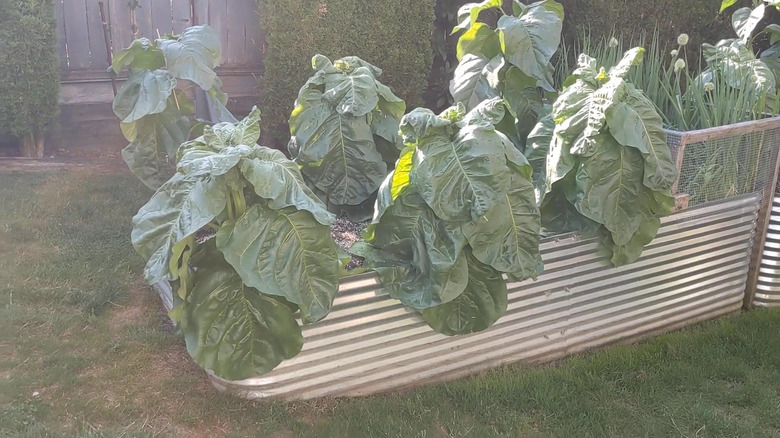
From solving cold cases to mapping past human migration, genome sequencing has led to some significant scientific breakthroughs in the past few decades. As far as plants go, this technology has changed classification systems. A good example of this is the reclassification of Nicotiana rustica, a member of the Solanaceae family; DNA research helped determine that Peru is its country of origin, even though it had arrived in Europe in the 16th century. The plant boasts pretty yellow flowers and is a once-popular, now old-fashioned herb that today's gardeners rarely grow — to their detriment.
Nicotiana rustica goes by a few names, though wild tobacco and Aztec tobacco are the most commonly used options. It's also sometimes called Indian tobacco, but it's better to avoid using that name because it can be confused with Lobelia inflata. The latter species isn't a tobacco. Nicotiana rustica is a tobacco species, and it was even once used as smoking tobacco, only to be replaced by the milder Nicotiana tabacum in the early 1600s. Nicotiana rustica is still grown in North and South America, and seeds are available online for gardeners who want to grow it as a quirky ornamental.
Why should you consider planting this flowering Nicotiana in your garden? Like the more common Nicotiana alata, Nicotiana rustica is most often grown as an annual, blooming from July to September. The two- to five-foot-tall plant has short, yellow, tubular flowers that attract insects seeking nectar and refuge; use it to add some interest to your pollinator garden. All parts of the plant are highly toxic to humans, dogs, cats, and livestock if ingested, so think carefully about where in the garden you plant it.
How to grow old-fashioned Nicotiana rustica in your garden
The small tubular blooms of Nicotiana rustica open in the morning, attracting small bees and other insects that are active early. Jasmine tobacco (Nicotiana alata), the fragrant night-blooming plant that hummingbirds can't resist, blooms at night. You could provide an all-day nectar buffet for pollinators by growing the two plants together. Another great reason to grow this plant is its deer resistance.
Nicotiana rustica will naturally reseed in a flower bed, but to ensure germination, it's better to start seedlings indoors about 10 weeks before the last frost. The seeds are incredibly tiny and need light to germinate, so don't bury them too deeply in the growing medium. Keep the seedling trays in a room where the temperature is around 68 degrees Fahrenheit. Germination takes about 10 to 20 days, so be patient.
Like many other flowering annuals that will last all summer, Nicotiana rustica grows best in rich, well-drained soil that's kept consistently moist. It will tolerate sandy, loamy, or clay soils, but it may not reach its potential. Either way, it requires a full- to partial-sun site. You can expect this plant to reach five feet tall when mature; use it to add a vertical element to your garden design. One interesting quirk is that Nicotiana rustica uses day length rather than temperature to decide when to flower. The plant requires a photoperiod of more than 14 hours to bloom, something that's determined by latitude. You may not get blooms if the days aren't that long where you live.