

The Most Low-Maintenance Fence Materials Are Also Some Of The Cheapest
We may receive a commission on purchases made from links.
If you're trying to build the perfect fence for your home, you'll need to choose the right material. While traditional wood fences provide plenty of durability (especially if made of cedar or redwood), along with a classic aesthetic, they do require maintenance, such as keeping vining plants away, as well as sprinklers. Metal fences, meanwhile, require less upkeep, but can be costly, especially if you go for an intricate wrought-iron design. But these aren't the only options for fencing, and luckily, it turns out that the most low-maintenance fence materials are also some of the cheapest. For a no-nonsense fencing option, consider a vinyl or chain link fence.
The cost of a wood fence today can vary greatly depending on the specific material and design but at the high end you can expect to pay at least $5,000 to $8,000 for the average yard. Your region is also a factor, with certain areas of the U.S., such as the Midwest, typically having higher installation costs. Metal fences can be even more expensive, topping out at over $10,000 for materials and labor. Of course, that price will only increase the more fencing you install.
While some vinyl fences can be on the pricey side, too, on average, they cost hundreds of dollars less than wood or metal. Chain link is the cheapest common fencing material available, costing less than $2,500 for a 150-foot fence in some areas. A cheaper price tag doesn't equal a low-quality fence either; both chain link and vinyl fences are durable — while also being easy to maintain — making them a great solution for many homeowners.
Chain link and vinyl fences are easy to maintain
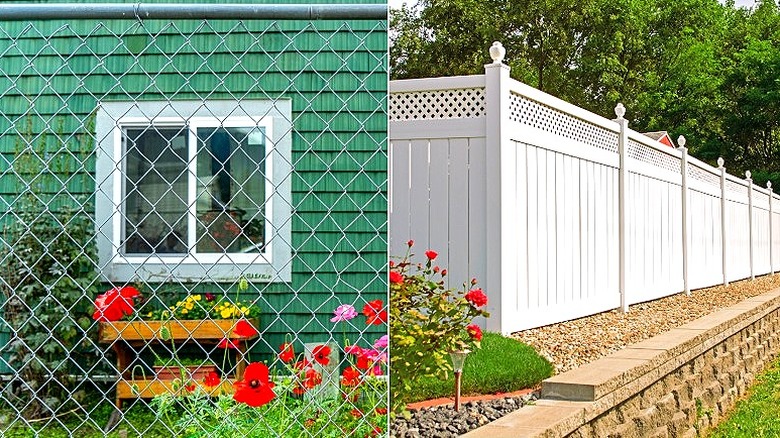
One of the biggest draws of vinyl fences is the wide range of available styles. If you still want the natural look of a wood fence, for example, you can find vinyl fence panels that share the look while being much easier to care for. The usual collection of dirt and grime that collects on fences can be washed away with a garden hose or pressure washer, while many larger stains can be cleaned with soap and a scrub brush. To make things easier, you could also go for one of the vinyl fence colors that hide dirt best, like a gray or a tan. Vinyl fences also don't rust, and when regularly checked for mold and damage, can last for over 20 years.
Chain link fences get a bit of a bad rap for looking industrial or unwelcoming, but in some cases, they're exactly what a property needs to feel more secure. There are also dozens of ways to make a basic chain link fence look better and add curb appeal. What's more, if your home borders a tree line or any patch of wilderness, a chain link fence can help keep critters out without obstructing your view of the environment.
As with vinyl, a chain link fence can be cleaned by spraying it down with soap and water, and while the material can rust, you can avoid that issue with a product like Rust-Oleum seal coating spray. Another option is to go with a combination of both fence materials: vinyl-coated chain link.