

Not Jadeite: The Beautiful Anchor Hocking Glass Color That Collectors Dream Of Finding
Collectors around the world often love the look of valuable vintage jadeite dishware for its opaque, milky-green hue. Jadeite glass manufactured by Anchor Hocking is especially popular because it was designed for everyday use and remains sturdy today. In addition, many savvy collectors have another Anchor Hocking color on their radar: Sapphire Blue.
Still a mainstay in kitchens today, Anchor Hocking started making glassware at its Lancaster, OH plant in 1905. By the 1930s, the company was one of the most well-known makers of Depression Era glass. In 1942, Anchor Hocking pioneered their new line of heat-proof glassware, naming it "Fire-King." Like Pyrex, Fire-King glassware was made from borosilicate glass, which made it incredibly heat-stress resistant. From 1941 to 1956, the company created the "Philbe" Sapphire Blue Ovenware as part of its Fire-King lines. Blue Sapphire was also used in Anchor Hocking "Bubble" glassware, the nickname collectors use for pieces with large raised round embellishments.
Both the regular and Bubble glassware can be valuable on the secondhand market, as eBay auctions can attest. A vintage bubble salad bowl can be priced at nearly $60. Many buyers prize the Sapphire Blue containers because they are still useful today, which is probably why a set of four glass containers with lids can go for $50. If you want to start with the basics, a set of six dinner plates from the 1940s can sell for around $35, making them a great entry point for a new collector bewitched by the blue hue.
Spotting Sapphire Blue while thrifting
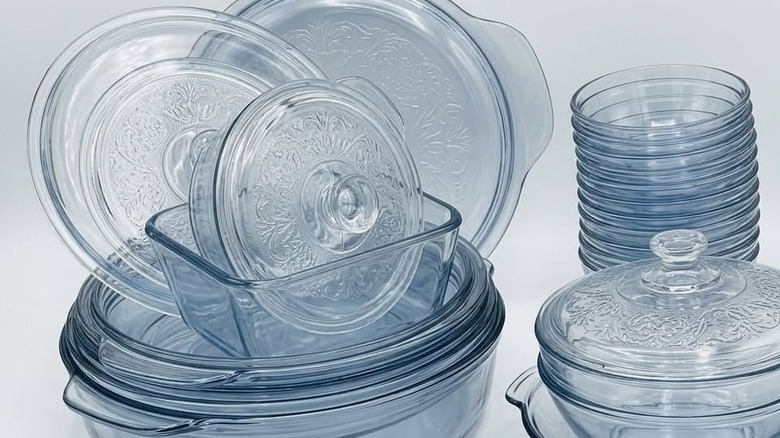
The vintage Fire-King Sapphire Blue pieces are relatively easy to identify because the sides are stamped with an embossed design called "Philbe", named after the designer Phil Bee. The bottom of the pieces will include the classic Anchor Hocking mark of an anchor with the letter "H". If the piece says "FIRE-KING" in block letters, it was likely made in the 1940s. Some pieces are also stamped "Made in the U.S.A."
You can also identify Sapphire Blue dishes because of their appearance. The pieces have a translucent blue tone that lets light pass through the glass. The colors are not always consistent. Thrifters may find dishes that are clear with just a hint of blue, while in the bubble pieces, the blue may appear to be more saturated shade.
The next time you're at an estate sale or thrift store, make sure you look for valuable glassware worth buying. And be sure to keep an eye out for depression glass in all its colors. You may discover a new item to display for your vintage kitchen, or challenge yourself to set up an entirely thrifted table.