

What To Do If You Spot Ants Around Your AC Unit
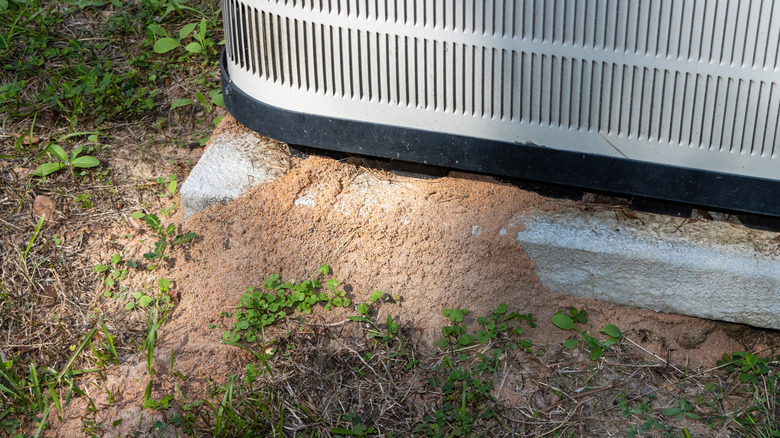
In some cases, you should actually avoid killing ants in your garden. Colonies can help to aerate the earth as they dig their complex underground tunnel systems. Not only that, they predate on various other pest species, and are, overall, an important part of your garden's biodiversity. However, one important exception to this rule is if ants are beginning to make themselves at home near your AC unit. Tawny crazy ants (Nylanderia fulva), in particular, represent a serious risk of damaging your unit, since they don't tend to dig their own nests and instead look for existing cavities to move into — including those with delicate electrical equipment. If that happens, they can come into contact with electrical components, causing the circuits to short.
That sounds drastic, and we'll admit that it's far from ideal. However, if you've noticed ants coming and going from your AC unit and you suspect that there's a colony inside, it's important to think carefully about how you'll deal with them. You certainly don't want to go spraying foreign chemicals over the AC unit in a bid to kill the ants that you can see. Not only will that likely miss the majority of the colony, but you could end up spraying sensitive components and damaging your AC unit. Instead, you should inspect the area, work out the types of ant that you're dealing with, and then build a plan of action from there.
How to tackle ants around your AC unit yourself
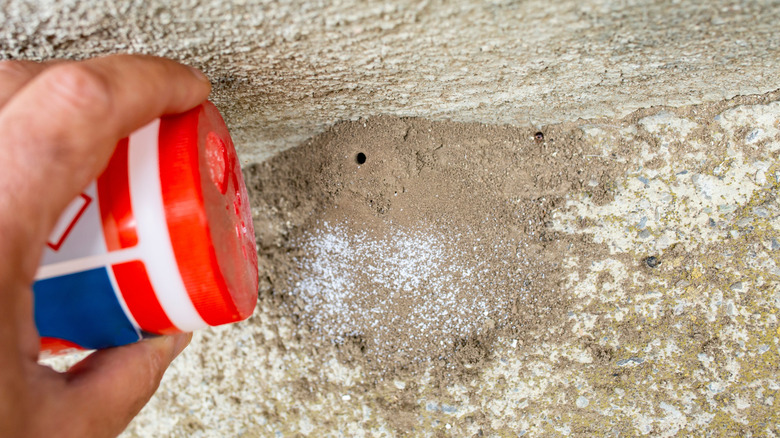
If you find that the ants are being drawn to your AC unit from elsewhere in the garden, then take a closer look around your unit and see if there are any attractants. Depending on which type of ant is plaguing your garden, there are several things that could be enticing them. Some will be drawn to uncleared garbage, organic leaf matter, fallen fruits and berries from nearby plants, or seeds scattered from your flowers. However, if it is, indeed, tawny crazy ants that you see marching around your unit, then it could be the shelter provided by your unit itself that's drawing them there. To be safe, clear away any potential food sources, and monitor the area to see if that slows the flow of ants. At the same time, aim to remove any decomposing layers of mulch from the area, as this could also be attracting the insects.
If these steps don't work, or if you believe the ants are coming from inside the unit, then you'll want to take more drastic measures. The best method to remove an ant infestation is usually to apply bait. The bait attracts the ants like any other food source, only it's laced with poison. Unlike sprays, which only kill the ants that you see, bait gets taken by the ants back to feed the entire colony, where it works to destroy the entire nest.
When to call a professional to deal with ants around your AC unit
The ability to deal with an ant infestation yourself depends on a couple of factors. One is the type of ant that's causing the problem. In the case of tawny crazy ants, whose populations can explode at alarming rates, it really depends on how early you catch the problem. If you spot the signs early, then baiting is usually the most effective method of control. However, if the colony is well established, it could well be spread across numerous properties, and with more than a single nest site. In that case, bait stations can often prove ineffective against these ants.
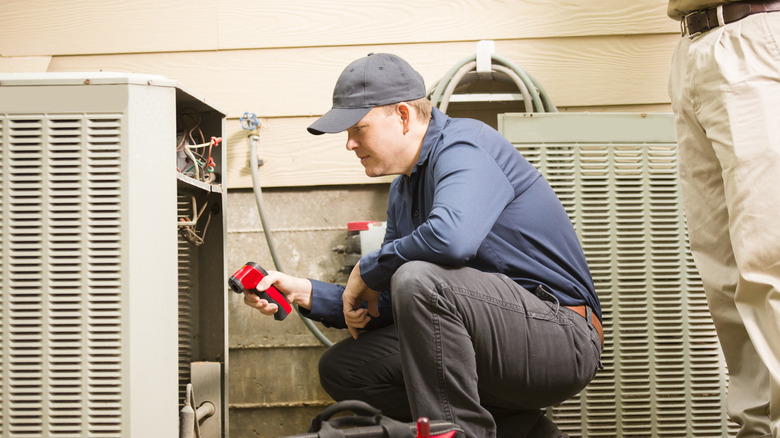
Not only that, but if there are huge numbers of ants inside your AC unit, the chances of electrical shorts, damage, and even system failure begin to increase. Even if the bait is effective, you may find that the interior of your unit is absolutely covered with the carcasses of dead ants. For these reasons, if you suspect that there are lots of ants inside your unit, it's generally best to call a pest control specialist. Once the colony has been dealt with, it could then be worth enlisting the help of a professional HVAC technician. They'll be able to take your AC unit apart, inspect it for damage, and clean any detritus and dead ants from inside the system.