

Are Smart Air Conditioners Worth Buying?

Do you ever think about how nice it'd be if you could turn on your air conditioner before you even get home? Or, maybe you wish the AC could adjust the temperature to your liking automatically, by learning and monitoring your habits. Also, wouldn't it be nice if you could turn it off from anywhere instead of it running unnecessarily on the days you forget to power it off? While a regular AC can't give you these benefits, a smart unit can. Since it connects to your home's Wi-Fi, you can easily control it through your smart phone or voice assistant. Bonus advantage: You won't have to deal with remotes or ensure your kids don't hide them away. Alas, these comforts come at a cost — you'll have to shell out hundreds of dollars to buy a smart AC from a trustworthy and reliable appliance brand.
And this raises the important question: are they worth buying? Well, if you're on a quest to make your house a smart home or you value convenience above cost, you might find their price tag justified. It can also be a nice addition if you're trying to actively reduce your carbon footprint, but can't survive extreme heat waves without the comfort of an AC. That being said, if your primary concern is the upfront cost, you might want to stick to a regular model. Also, if you aren't tech-savvy, smart ACs can be difficult to operate or use in tandem with your other smart devices, such as Google Home or Alexa. Some models might not even be compatible with your current thermostat, leading to additional costs for a replacement.
Pros of smart air conditioners
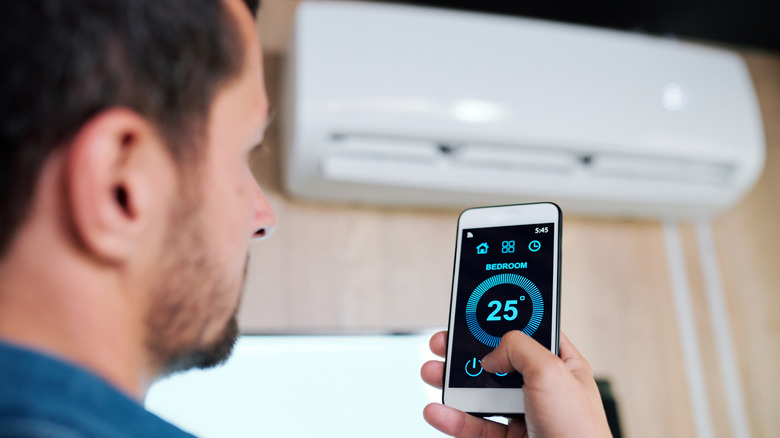
Turning your phone into an AC remote is perhaps the biggest pro of smart air conditioners. The ability to control the AC through voice assistants like Alexa is a close second. This means you can adjust the temperature, as well as turn it on or off, while you're stuck in another meeting-that-could-have-been-an-email or lounging in your comfy bed. These features also make smart ACs more energy efficient than standard ACs. Moreover, certain models will send energy usage reports to your connected devices. This way, you get to keep track of the amount of electricity they're consuming and make adjustments to consciously lower your energy consumption and utility bills. Switching over to energy-saving modes will help, too.
You can also set a schedule so your AC automatically adjusts the temperature or turns off based on your preferences and lifestyle. Many units even come outfitted with a dedicated Sleep Mode, so you can catch some Zs and not wake up in the middle of the night sweating or freezing. Geo-fencing is another notable feature: Certain smart ACs can use a connected smart phone's GPS signal to learn about your location. Based on this information, they can turn on (if you're about to enter the home) or off (if you're moving away from the home base). Plus, such models tend to monitor a room's temperature, humidity levels, and occupancy in real-time, so they can modify the cooling temperature and fan speed without manual assistance.
Smart ACs are often easier to maintain as well. Many models will notify you when the filters get filthy and require a clean-up. Additionally, they can identify issues hampering their performance, so you can fix them right away instead of spending time trying to decode what's wrong.
Cons of smart air conditioners

Besides their higher cost, the biggest con of smart air conditioners is their reliance on a stable network connection. In other words, if people are secretly stealing your Wi-Fi or you don't have a high-speed or strong internet connection, your "smart" device will turn "dumb." This means it won't be able to monitor your home's internal environment and adjust itself in real-time or respect the boundaries of geo-fencing. Other advanced features will also be limited. Also, the communication lines between your other smart devices and the AC might get compromised, so you may have to manually turn it on or off and change the settings.
Further, the self-diagnosis feature can be a double-edged sword, especially if your AC model has a history of raising false alarms or the internet connection is weak. If there's no dependable customer support, you'll either have to turn toward YouTube University or user-first platforms, such as Reddit or Quora, to fix the glitch yourself. Moreover, smart AC repairs or replacements can be a costly affair.
The last con is the privacy issues related to these units. Your device will have considerable access to information about your lifestyle and preferences, and you have to feed it personal data to customize the settings as far as possible. And if an unscrupulous third-party or cyber criminal got hold of this information, they could use it to their advantage without your consent. To prevent this, it'll be necessary for you to pick a strong password and keep updating it on a regular basis.