

How To Tell If Your Blue Cornflower CorningWare Dish Is Valuable Or Not
If you're decluttering your kitchen, you may want to check that long-forgotten Blue Cornflower Corning Ware hiding in the back of a cabinet twice before adding it to the thrift store pile. The pattern on its own isn't a guarantee it's worth much, but there's always a possibility.
As one of Corning Ware's most recognizable designs, Blue Cornflower dates back to 1958, when the brand launched. Because the first Blue Cornflower release was limited to four pieces, they have much more value than later models. One 1958 Blue Cornflower baking dish, for example, reportedly sold for $149 on eBay, but other eBay listings show more common Blue Cornflower pieces changing hands for as low as a few dollars. So while most aren't worth a fortune, certain pieces and complete sets can sell for more.
To assess your own, start by looking at the markings on the underside. You may see alphanumeric markings such as B-34, but these aren't model numbers — they're glass mold numbers used for quality control. The P-series model numbers were introduced in the fall of 1961, so pieces from 1958 and 1959 won't have this particular model-number system. These early pieces from will instead have embossed markings pressed into the bottom.
Rarity matters more than the blue flowers
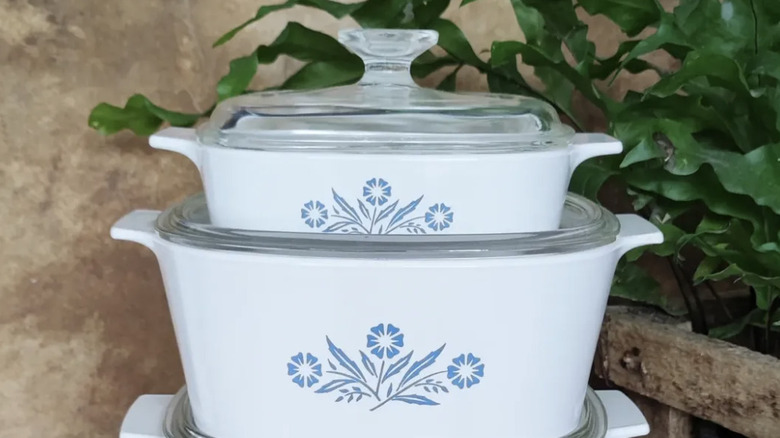
What makes a piece appealing to collectors doesn't usually come down to the pattern alone — the Blue Cornflower pattern was produced from 1958 through 1987, so it isn't exactly rare. The pattern appeared on casseroles, percolators, teapots, platters, and many other forms, meaning some Blue Cornflower pieces are considerably less familiar than the standard casserole dish. Instead, look at the particular version or form. For example, because the earliest Blue Cornflower cookware was made in a limited release at first with just a 1-quart, 1.5-quart, and 1.75-quart saucepans and a 10-inch skillet, these are more of an exciting find for anyone looking for vintage dishware at the thrift store.
The earliest Blue Cornflower casseroles also had sloped sides (later versions became straighter), so collectors consider those early pieces more desirable. The original 10-inch skillet can also be identified by its matching white Pyroceram lid decorated with Blue Cornflower. Another example is the original Blue Cornflower P-108 percolator. The P-108 was an 8-cup percolator introduced in 1959 and its original design was made entirely from Pyroceram, but Corning discontinued it in 1960 and replaced it with the 9-cup P-119. Specialist collector reference site CorningWare 411 describes the original version as "extremely rare."
But the rarity of the dish can only go so far — chips, cracks, heavy scratches, missing lids, and whether you have a complete set could all factor in how much a collector will be willing to pay. For example, a full seven-piece Blue Cornflower set sold at auction for $115 in 2024, which shows the value of having a larger collection. Even if you don't, though, you should try to remove stains from bakeware before you list it.