

Safe Southern House Spider Vs Dangerous Brown Recluse: How To Tell Between Them
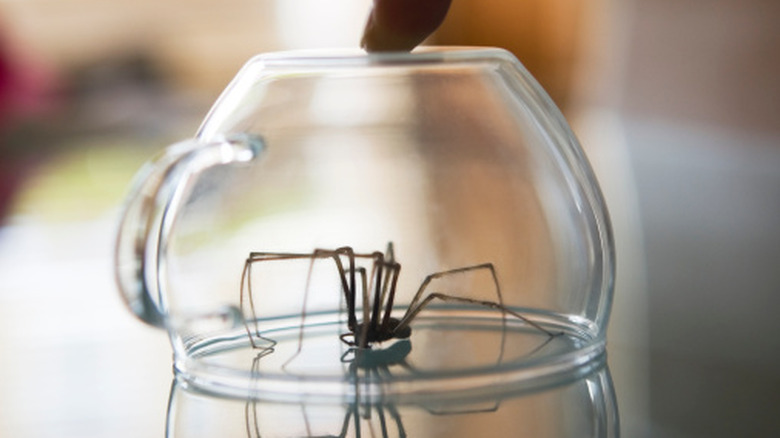
Whether you're an arachnophobe or an arachnophile, it's smart to be able to recognize the venomous brown recluse spider (Loxosceles reclusa) if you live in one of the regions they inhabit. Of course, the brown recluse doesn't have a very striking or remarkable appearance, which is partly why they're so dangerous. You might find an arachnid in your home and think it's a brown recluse, but it could actually be a safe species. Before you panic, know how to tell the difference between them. southern house spiders (Kukulcania hibernalis) are among the spiders in your house that might be mistaken for the brown recluse. You can tell them apart by looking at their size, number of eyes, and other distinguishing characteristics.
One key way to tell the difference between these two arachnids is to look for markings behind their eyes. Brown recluses are also called fiddlebacks or violin spiders – and there's a good reason for this. There's a marking right behind the spider's eyes that looks like the body of a violin, with the neck of the violin pointing towards the rear of the spider. Size and number of eyes are another clear way to distinguish between the two species. Brown recluses have a brown- to tan-color, are medium-sized, and have three separated pairs of eyes. Southern house spiders are bigger than brown recluses – some say they look like small tarantulas — are brown or grayish-brown in color, and have eight eyes all grouped together.
Look for markings, pedipalps, and other context clues
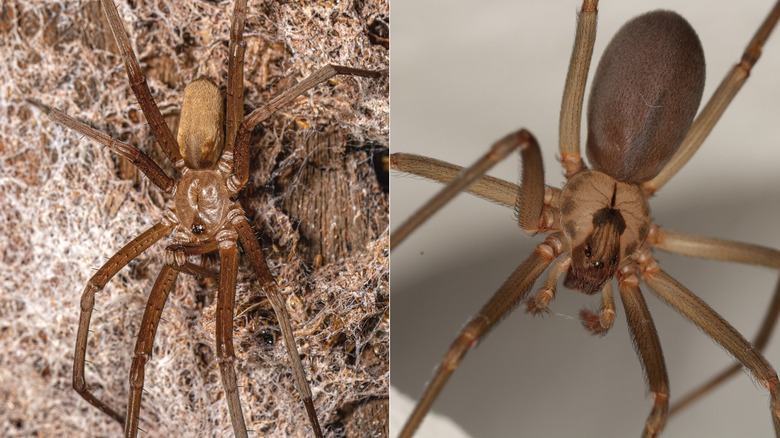
You're more likely to confuse a male southern house spider with a brown recluse. Male southern house spiders (pictured left) have very long pedipalps, almost like an extra pair of legs. Brown recluses (pictured right) also have visible pedipalps, but they are shorter and wider-set. If you are able to examine the arachnid in question with some calm, when looking at L. reclusa, you'll notice that the rest of the body has no pattern on it. In contrast, female southern house spiders have white markings where their legs join their body.
Comparing the two species' webs and habitats may also help you tell the difference between the two. If you spot any brown recluse spider webs around your home – you'll see that they are small, look like cobwebs, and don't have a well-defined pattern. On the other hand, the webs of K. hibernalis have a radiating structure, and may lead into a cavity.
A bite from either of these species can be unpleasant, but the severity and healing time also indicate the species. Although brown recluses aren't aggressive, one might bite you if you accidentally press against it against your skin. Some individuals do have severe reactions. Brown recluse bites can be very painful, followed by intense symptoms like necrosis, and leave behind a hole-punch type scar. If a southern house spider bites you, on the other hand, it might be painful, but there's not the same risk of severe symptoms as there is with L. reclusa. If you determine that you need to deter brown recluse spiders from your home, you can learn to recognize and allow natural predators that prey on the venomous fiddlebacks, such as wolf spiders.