

Painting Your Room Is Supposed To Be A Cheap Makeover. It's Not.

When you think of cheap room makeovers, your mind probably goes straight to paint. What could be costly about throwing a layer of paint on an old, boring wall? Sure, the paint itself costs a few bucks, but surely less than brand new furniture. Oh, except you'll probably need some paint brushes, too. A few rollers, maybe. And then there's painter's tape, primer, and a tray. But all that can't be that expensive, right? Wrong. Painting your room is supposed to be a cheap makeover, but it's not.
When I moved into my first adult apartment after college, my landlord informed me that I could paint the walls as long as I ran the colors past him. Could a light pastel yellow make my bedroom feel warmer during cold Canadian winters? Would a creamy white be able to conceal the marks that the former tenant had left behind in the living room? It sounded fun, cheap, and doable. A fresh start and an achievable step into adulthood, I thought.
That's when a hardware store attendant popped my bubble. To paint the living room alone, I'd need two gallons of paint. From a company like Benjamin Moore, that's already $180 for paint alone. I'd also need some paint for the ceiling, he said, so add another $60 or so to the total. And since this was my first paint job, I needed to get all the supplies: rollers, rolling sticks, tarps, and brushes; that's another $50. Dropping nearly $300 to paint a rental I would only spend a year in wasn't exactly the cheap makeover I had in mind. Instead, I spent my money on wall art to create a perfect gallery wall, and got a vintage coffee table from a thrift store.
The true cost of painting a room
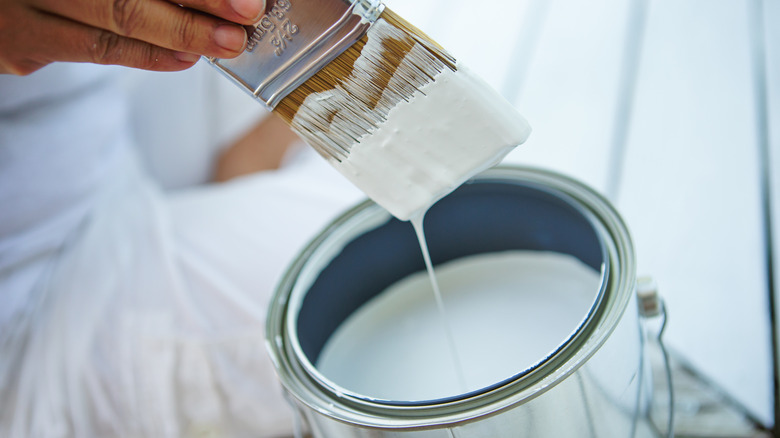
I'm not alone in this. Paint is often touted as a budget-friendly way to make over a room. With some rollers and a free afternoon, you could cover a wall in white to make it look fresh and clean. Or, with maximalist style trends taking over interior design, you could use paint to create bold and colorful accent walls, like the checkered wall paint trend. It's all so tempting.
On average, a gallon of interior paint costs between $20 and $70, and some high-end brands will charge closer to $120 for a gallon. When calculating how much paint you really need to buy, you'll often end up closer to two or three gallons, like I would have for that living room. It depends on two things: the size of the room you're painting, and the number of coats you'll need. Quality paints can let you get away with two coats (one, if you're not changing the color of the wall), but cheaper paints can be patchy and therefore require more coats to achieve a spotless finish. All that to say: If you try to cut costs by going with a lower quality paint, you'll end up needing even more buckets. Not so economical after all.
And before you even start painting, you need to apply primer. Here again, the cost depends on the quality of the primer. Cheap ones at Walmart cost as little as $16 per gallon, while Sherwin-Williams and Benjamin Moore primers cost between $50 and $90 per gallon.
How to decide if painting is the right move, and what to do instead

In addition to the price of the paint, consider all of the other stuff you'll need to purchase for the paint job. A starter kit can cost under $50 — but it's not just about the monetary cost, it's also about organization. Once you've got a whole bunch of painting supplies, you'll need to store everything somewhere. Ideally, you only want to invest in those things if you think you'll need them again down the line; otherwise, they're just cluttering your space for no reason.
So, when deciding whether to paint over a room, ask yourself whether this is a one-off project or a long-term investment. If you own your house, investing in paint and painting supplies might be worth it. But it's not a "cheap" or "quick" makeover; it's a proper renovation project.
On the other hand, if you're in the same situation I was in after college, consider other (actually budget-friendly) ways to make over a room. For example, swap out curtains and replace light fixtures. And curtains aren't just for windows; if a specific wall is truly too damaged, stained, or hideous for you to deal with, cover it with drapes. Or, create a gallery wall with all your favorite posters, photos, and framed art. And if you rent, paying for paint isn't smart budgeting. Instead, ask your landlord to paint the wall. In some cases, it's even expected of the landlord to handle these paint jobs every few years.