

Repel Ticks Naturally With A Fragrant Essential Oil They Can't Stand

Ticks lurk in high grass in the summer, waiting to bite into mammals and feed on their blood. When children play in the yard or the woods, it's very likely that ticks will attempt to hitch a ride. The same applies to pets, and the ticks can travel from those pets to their owners. One of the best ways to keep ticks out of your yard by removing common things that could be luring them, including tall grass, stone walls, compost piles, and piles of leaves. However, there are times when you have to venture out, and it's good to have a layer of protection. These bloodsuckers are usually just an annoyance, but they can sometimes spread deadly diseases, such as Lyme disease, Rocky Mountain spotted fever, and a red meat allergy called alpha-gal syndrome. But there is one plant with an essential oil that can keep them away, and that is sweet fern (Comptonia peregrina). Its odor smells sweet to people, but it is believed to repel ticks.
There are several ways to avoid ticks during their peak months of April through September. Over-the-counter bug sprays can also do the trick, but many folks would prefer to avoid using chemicals like DEET on their skin. This is why sweet fern is an excellent option, as you can make your own insect repellent that actually smells good. Sweet fern oil can be purchased in stores, online, or even distilled yourself. It is safe for skin when properly diluted, and has even been used to treat rashes and insect stings.
Sweet fern essential oil has tick-repelling properties
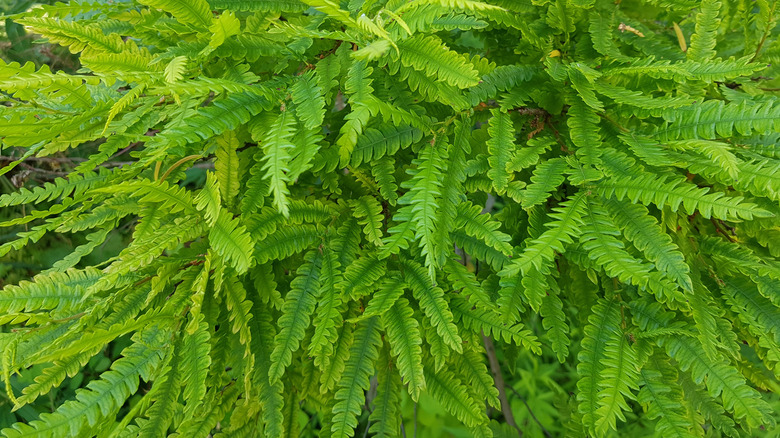
A 2026 study published in Experimental and Applied Acarology found that the essential oil of sweet fern contains a few key compounds, including eucalyptol, β-caryophyllene, terpinene-4-ol, and γ-terpinene. The study showed that after applying these compounds to a bait mixture, only about 7% of the ticks still attempted to crawl to the bait. More research is needed to fully understand why ticks avoid sweet fern oil, but it's speculated that the strong scent could irritate them or send mixed signals to their pheromone receptors. Caryophyllene, in particular, shows promise at repelling a variety of arthropods, including ticks.
However, unlike artificial insecticides like DEET, sweet fern may not kill ticks. In another case, a writer publishing under the blog Uni of Nomi conducted a series of experiments involving sweet fern oil and ticks. At first, they discovered that the ticks seemed to have died within roughly 15 minutes of contact with the oil. However, later repeats of their study revealed that many ticks had not actually died, but might have experienced a temporary paralysis as a result of the sweet fern oil.
Still, if you're interesting in a natural method of repelling ticks, using sweet fern could be worthwhile. Applying it topically might yield the best results, but it should be diluted with a carrier oil before spraying onto skin. A method normally used for mosquitoes, you can also try charring the leaves in a campfire, bowl, or ash tray to produce smoke that keeps ticks away. For those with a green thumb, sweet fern is also one of many shrubs with edible parts that you can grow in your yard.