

Forget Mums: These Dramatic Flowers Bloom In Late Summer Through The Fall
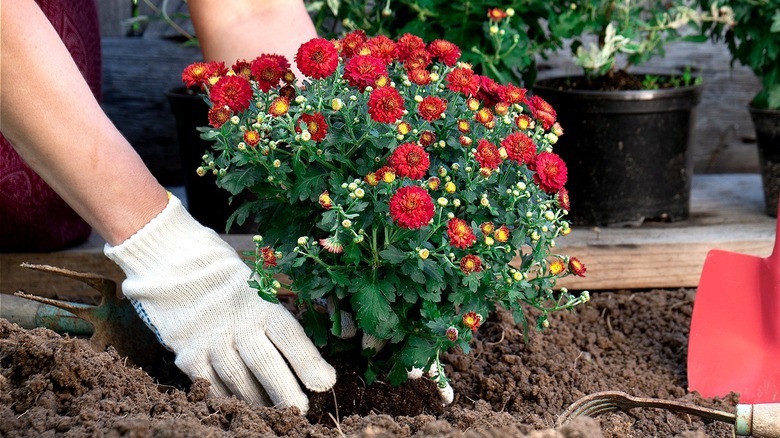
Garden mums unwittingly dominate the talk of fall displays. With their colorful petals, pom-pom forms, or edible leaves you can brew for teas, they keep winning hearts year after year. However, if you're hoping to rejig your beds and pots and are on a lookout for stunning alternatives to mums for long-lasting color, consider Peruvian lilies (Alstroemeria spp.) instead. They're often on display from late spring into fall, taking a brief break only during extremely hot summers, when temperatures exceed 80 degrees Fahrenheit.
With a colorful palette that runs the gamut of pink, salmon, red, purple, white, and yellow, and attractive pattern markings, Peruvian lilies inject lots of drama wherever planted. Besides, they draw in many pollinators, including butterflies, hummingbirds, and bees. Native to Chile and Argentina, they bring a tropical touch even while it's autumn. Even when they aren't actively blooming, they appear attractive thanks to their twisted leaves.
Available in a wide range of cultivars and varieties that boast distinct variegation in flowers and foliage, such as 'Summer Breeze,' 'Pacific Sunset,' and 'Indian Summer,' you're sure to find a plant that best fits your garden scheme. Bear in mind that they often require net or stake support, since they can tower 4 feet high in some cases. Though you may be able to dispense with staking for compact cultivars.
How to grow Peruvian lilies
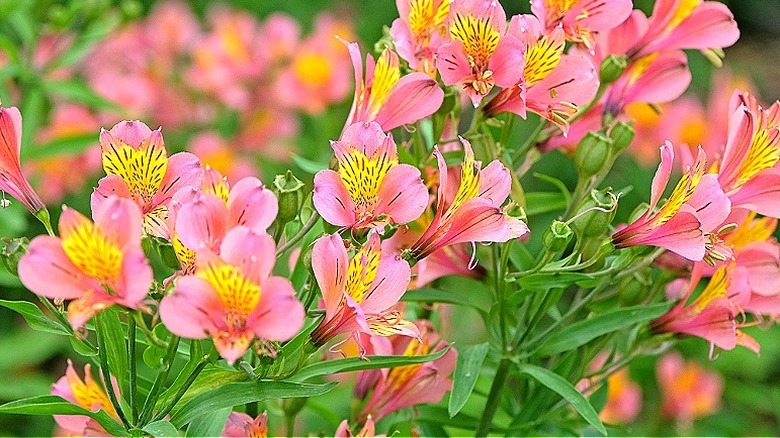
Unlike mums that can be grown in zones 3 through 9, Peruvian lilies enjoy a limited range. They remain perennially hardy in zones 7 through 10, though some cultivars may overwinter successfully up to zone 6 if provided winter protection. Where not hardy, some nifty gardeners dig them out from the ground before frost and grow them indoors as houseplants. While others, to avoid such labor, simply pot up Peruvian lilies and relocate them as desired.
Peruvian lilies prefer sites where they'll receive full sun exposure. But in southern climes where afternoons can feel unbearably hot, they perform better in lightly shaded spots. Since they're tall and you don't want to end up with a bedraggled bed, locate them in a sheltered spot where they won't catch the wind drifts. In terms of soil, they're particular about drainage and high organic content. So, you may want to amend the soil beforehand or at the time of planting with compost, especially when planting in clay soil.
While you may grow them from seeds, Peruvian lilies are best started from rhizomes or tuberous roots. Since their roots are highly delicate, it's ideal to plant the rootball about 6 inches deep, be it in garden soil or a pot, without attempting any detangling. Backfill and lightly firm the soil afterward. Unless you're growing a patented variety (the plant label would mention this), you can divide these plants when beds feel overcrowded for new plants, if so desired.
Caring for your Peruvian lilies
After the plants have established, keep up a consistent watering schedule, since you don't want the beds to dry out. But naturally don't overwater either, or rot may set in. Besides, it may also create an inviting habitat for mollusks, which is why some accuse this exotic plant of luring slugs and snails to your garden. Peruvian lilies can produce about 80 flowering shoots annually, which makes them resource hogs. To keep them looking their best, you must supplement with a slow-release, nitrogen-rich fertilizer, like 12-4-8, in early spring.
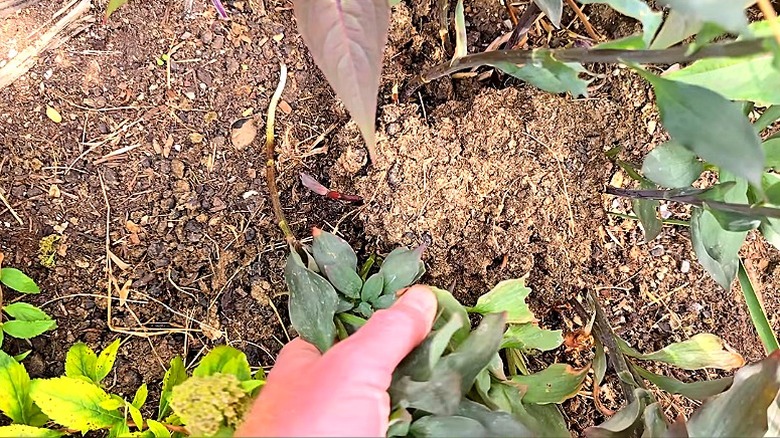
Deadheading or pruning the plants regularly is also essential to prolong their blooming season. Rather than cutting off the dead flower, yank out the spent flowering stem (pictured above) until it snaps with a loud pop right from its base. This will stimulate the growth of new shoots while keeping their self-seeding tendencies under check. This technique also works if you're harvesting their flowers for indoor arrangements, where they can usually last for a fortnight.
That being said, note that because of their underground rhizomes, Peruvian lilies can become weedy. While this feature is useful to fill out a bed and keep weed pressure down, it may become problematic in formal beds. So, unless you're willing to remove volunteers, best keep your lilies containerized. Other than slugs and snails, the usual garden pests, like aphids, whiteflies, and spider mites, may attack your lilies. Keep a hose and horticultural oils on the ready to get rid of them the moment they appear in your garden.